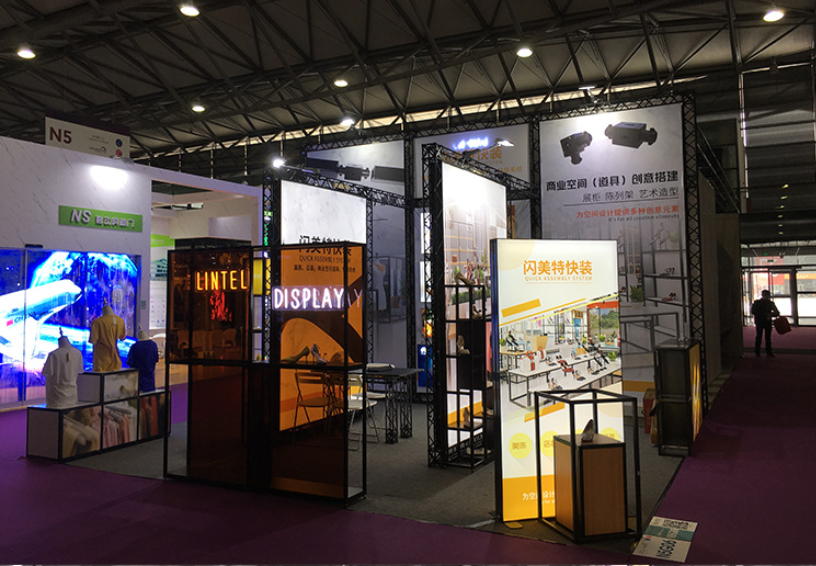
What is the core difference between modular booths and traditional custom-built booths?
From structure to installation method: the fundamental differences between the two types of booths
Traditional custom-built booths are a project-specific construction process, where carpenters cut, nail, and paint on site, building the booth from scratch, and most materials are scrapped after dismantling. Modular booths, on the other hand, use a modular assembly process, with frames made of high-strength aluminum alloy and connectors made of reinforced engineering plastic plus carbon steel. All components are prefabricated in the factory, and on-site assembly only requires combining and fitting them together.
The differences between the two are mainly reflected in two aspects:
Different structural logic. Traditional custom-built booths are primarily wood-structured, relying on panels and keels to build the load-bearing system, formed in a one-time process. Modular booths use a high-strength aluminum alloy frame as the main structure, combined with engineering plastic and carbon steel connectors, forming a modular system that can be repeatedly assembled and disassembled.
Aluminum alloy frames are lighter and easier to transport than wooden structures, but the specific load-bearing capacity depends on the frame specifications and connection methods, and should be confirmed based on the actual weight of the exhibits.
The installation methods are different. Traditional custom booths rely on professional construction teams and power tools, involving processes such as cutting and painting on site. Modular booths are assembled using tool-free hand-tightened screws, and the connectors can be fixed by hand tightening without the need for drills, wrenches, or any power tools, nor do they require the operator to have professional skills.
Why tool-free assembly is so important for overseas exhibitions
The value of tool-free assembly in overseas exhibition scenarios is mainly reflected in two aspects:
Reducing dependence on local labor. The cost of hiring construction workers at overseas exhibition sites is relatively high, and local workers may not be familiar with the drawings, and language barriers may delay the project schedule. The tool-free design turns setup into a simple assembly process that exhibitors or temporary helpers can complete, reducing reliance on local construction crews.
It simplifies transportation and customs clearance processes. When disassembled, modular booths consist of neat aluminum alloy rods and panels, with a packed volume smaller than traditional custom-built loose parts, making transport more convenient. Additionally, as reusable standard goods, they pass customs inspections more easily than one-time construction waste.
It should be noted that tool-free assembly does not mean zero difficulty. Different specifications of modular booths have varying numbers and complexity of frame connection points, so it is still recommended to reserve time to familiarize yourself with the process during the first assembly. For large-area two-story structures or complex shapes, whether tool-free assembly is still possible needs to be confirmed with the supplier for the specific solution.
From setup time to transportation and storage: in which aspects do modular booths save more?
The cost of traditional custom booths is often not the booth space itself, but the three 'invisible bills' hidden in construction, dismantling, and logistics. The value of modular booths lies precisely in saving your budget and time in these aspects.
Construction Time and Labor Costs: How Tool-Free Design Changes On-Site Efficiency
Traditional custom booths typically require 4-6 professional workers with tools such as electric drills and cutting machines, taking 1-2 days or even longer. The core difference of modular booths lies intool-free hand-tightened screw assembly—no electric drills, no welding, and no professional construction qualifications required.
Taking the current modular truss booth as an example, its assembly method is tool-free hand-tightened screws, the frame uses high-strength aluminum alloy profiles, and the connectors are made of reinforced engineering plastic plus carbon steel. This means:
- Significantly reduced manpower requirements: 1-2 people can complete the setup, no need to hire an additional construction crew.
- Setup time compressed from "days" to "hours": The exact duration depends on the booth area and complexity, but the overall pace is much faster than traditional custom construction.
- Teardown is equally effortless: Simply reverse the assembly; no need to wait for professional workers' schedules, and you can quickly dismantle on the same day the exhibition ends.
For small and medium-sized enterprises, this directly saves two costs: one is the labor cost of the construction crew, and the other is the extra hotel and travel expenses during the setup period.
Transportation and warehousing: how modular structures reduce logistics costs
Traditional custom exhibition booths are mostly one-time wooden structures, which are bulky and heavy to transport, and are basically scrapped after dismantling, resulting in zero warehousing needs but huge waste. Modular booths, on the other hand, have a structural advantage in logistics due to their disassemblable design:
- Smaller transport volume: After disassembly, the trusses and connectors become rods and standard parts that can be tightly packed, significantly reducing the space occupied compared to integrally welded structures.
- Lighter weight: Aluminum alloy frames are much lighter than wooden or steel structures, directly reducing the chargeable weight for sea or air freight.
- Reusable: After dismantling, the booth can be packed into boxes for storage and reused at the next exhibition. The storage cost is offset by the value of reuse across multiple exhibitions.
Who is it suitable for, and who is it not suitable for?
- Suitable for: Companies that participate in more than 2 overseas exhibitions per year, need to control total construction costs, and want to reduce on-site construction risks.
- Not suitable for: Booths that pursue one-time ultra-complex irregular structures, require multi-level height or special load-bearing designs—such needs still require custom special construction.
What to confirm next? If you plan to exhibit overseas, it is recommended to confirm two matching points with the current website team: first, the single-box dimensions and total weight of the booth after disassembly, to calculate ocean freight costs;Second, the module count corresponding to the booth area you plan to exhibit and the estimated construction time. Only after these two items are confirmed can you accurately compare the total cost difference between modular booths and traditional custom booths in your specific scenario.
Customization and Reuse: Can Modular Booths Really Save Long-Term Costs?
Many buyers encountering modular booths for the first time have the first question in mind: Is this just a set of fixed-size "building blocks" that can only be assembled into a few standard shapes? The second question is usually: These look lightweight—can they survive more than three exhibitions?
These two questions directly determine whether "cost savings" holds true. Let's discuss them separately.
Degree of Customization: To What Extent Can Dimensions, Layout, and Brand Graphics Be Achieved?
The core of a modular booth is the truss structure system, not a "standard box." This means its dimensions and layout are not locked in. The trusses can be cut and combined according to the actual booth area, from a standard 3×3 small booth to a 6×6 or even larger custom area, all adaptable by adjusting truss lengths and connector layouts.
You don't need to change your booth plan to accommodate the modules; instead, the trusses conform to your booth boundaries.
For brand graphics, the surfaces of modular booths support custom printing. Whether it's lightbox graphics, fabric banners, or adhesive graphics applied directly to the trusses, they can all be produced according to your VI color codes and design files. In other words, the freedom of brand visual presentation is essentially no different from traditional custom booths—the difference lies in that the framework supporting these graphics can be dismantled and reused.
One key point to confirm is whether your booth has special structural requirements, such as a two-story structure, hanging heavy objects, or an irregular dome. These exceed the load-bearing range of standard modular trusses, so we need to confirm with the team whether there is a corresponding reinforcement solution.
Reuse value: evaluation methods from single-use cost to long-term returns
Whether a modular booth can be reused depends on two factors: material durability and assembly/disassembly wear.
The frame of this booth uses high-strength aluminum alloy, and the connectors are made of reinforced engineering plastic plus carbon steel. The advantage of aluminum alloy lies in its corrosion resistance, light weight, and resistance to deformation, while the carbon steel connectors better ensure structural strength during repeated tightening and loosening. With the tool-free hand-screw design, the assembly and disassembly process does not rely on forceful hammering, which in itself reduces wear.
Under standard industry usage scenarios, it is reasonable for this type of structure to support more than ten exhibition cycles with normal transportation and proper assembly—but the specific lifespan depends on whether the logistics packaging is adequate and whether on-site construction follows the correct sequence.
When evaluating long-term costs, do not only look at the single quote; use this simple formula to calculate:
Single-use cost = (product price + single shipping/warehousing fee + single setup labor cost) ÷ planned number of uses
Traditional custom booths are typically a one-time investment; wooden structures are basically scrapped after disassembly, and the single-use cost is the entire construction cost. The initial investment for a modular booth may be higher than a simple standard booth, but as long as it is used more than 3 times, the single-use cost will be significantly lower than rebuilding a custom booth. In addition, there is a hidden cost to consider: the storage volume of a modular booth is much smaller than the cost of disposing of waste wood, and the shipping weight is lighter, which directly translates into differences in logistics costs when exhibiting overseas.
Situations suitable for choosing a modular booth: participating in multiple trade shows a year, relatively fixed booth area, and brand graphics need to be updated each show but the structure remains unchanged. Situations not suitable: participating only once with no follow-up plans, requiring extremely complex irregular shapes, or having special load-bearing or hanging requirements for the booth—in these cases, traditional custom booths may be more straightforward.
The next step is to organize your exhibition plan (how many shows per year, booth dimensions, whether there are special structural requirements) and confirm with your team whether the current configuration can cover your expected reuse, and whether the accompanying packaging and shipping solutions match your overseas exhibition routes.
When should you choose a modular booth, and when should you choose a traditional custom booth?
The key to selection comes down to three points: frequency of use, transportation distance, and design requirements. Once you clarify these three points, the conclusion becomes clear.
Scenarios recommended for choosing modular booths: overseas trade shows, pop-up stores, and touring exhibitions
Overseas trade shows: Cross-border transportation is charged by volume and weight. Modular booths use aluminum alloy frames with detachable connectors, and after packing, their volume is much smaller than traditional custom-built booths. Moreover, they do not require professional construction crews; ordinary staff can complete the assembly. For companies that frequently participate in overseas exhibitions, savings in transportation and labor costs accumulate with each exhibition.
Pop-up stores, touring exhibitions, and brand promotional events: The common feature is 'short-term use and repeated use in multiple locations.' Modular booths can be disassembled and reused, with structural components that are not easily damaged, and the surface graphics can be reprinted—when moving to a new city, you only need to change the graphics, not rebuild the entire booth.
Corporate new product launch events: When the venue is not fixed or there are multiple events per year, the value of reuse increases with each additional event.
Scenarios where traditional custom-built booths are still suitable: single large-scale exhibitions, extreme design requirements
Single large-scale exhibitions with no plans for reuse: When pursuing extreme visual impact—irregular shapes, large illuminated ceilings, double-decker structures—traditional custom-built booths are constructed on-site by carpenters and welders, offering greater design freedom. Although modular booths support customization of size and graphics, their structure is primarily based on straight-line frames, with limited capability for complex curved surfaces.
Local exhibitions with ample construction time: When long-distance transportation is not required, the logistics disadvantage of traditional special decoration disappears, allowing more emphasis on form and appearance.
Budget Allocation Recommendations
PrioritizeReuse ValueandTransportation Costs。 The initial investment for modular booths may be higher than that for one-time booths, but when used more than twice or involving cross-border transportation, the overall cost is usually lower. It is recommended to evaluate the return on investment based on event frequency and venue changes, rather than only looking at the single construction cost.
Frequently Asked Questions
Do modular booths require professional workers to install?
No. Modular booths are assembled with tool-free hand-tightened screws, requiring no electric drills, wrenches, or professional construction qualifications.One or two regular employees can complete the setup, with the specific time depending on the booth area and complexity.
How many times can a modular booth be reused?
Under normal transportation and standard assembly/disassembly, it is reasonable to support more than ten exhibition cycles.The specific lifespan depends on whether the logistics packaging is adequate and whether the on-site assembly is carried out in the correct order.
Can modular exhibition booths be customized with brand graphics?
Yes. The surface of modular exhibition booths supports custom printing, including lightbox graphics, fabric banners, or adhesive graphics, all of which can be produced according to your VI color code and design draft.
Are modular exhibition booths suitable for all types of trade shows?
Not necessarily. Modular exhibition booths are particularly suitable for overseas trade shows, pop-up stores, roadshows, and other scenarios that require frequent setup and transportation.If you only need a single large-scale exhibition and pursue extreme custom shapes, traditional custom booths may be more appropriate.
Learn More
If you are planning to participate in an overseas exhibition, you are welcome to provide us with your booth dimensions, participation frequency, and special structural requirements. We will assist you in evaluating whether a modular booth is suitable for your scenario and provide a matching configuration plan.
Related Products:Custom Modular Truss Trade Show Booth | Tool-Free Quick Assembly Portable Exhibition System