How does the heavy-duty aluminum alloy frame resist impact forces at the exhibition site from a design perspective?
At the exhibition venue, the impact forces that the booth frame needs to withstand primarily come from accidental contact with foot traffic and minor collisions with materials. The stability of the heavy-duty aluminum alloy frame originates from the targeted design of its key components.
Why are 80 series octagonal columns more torsion-resistant than square tubes?
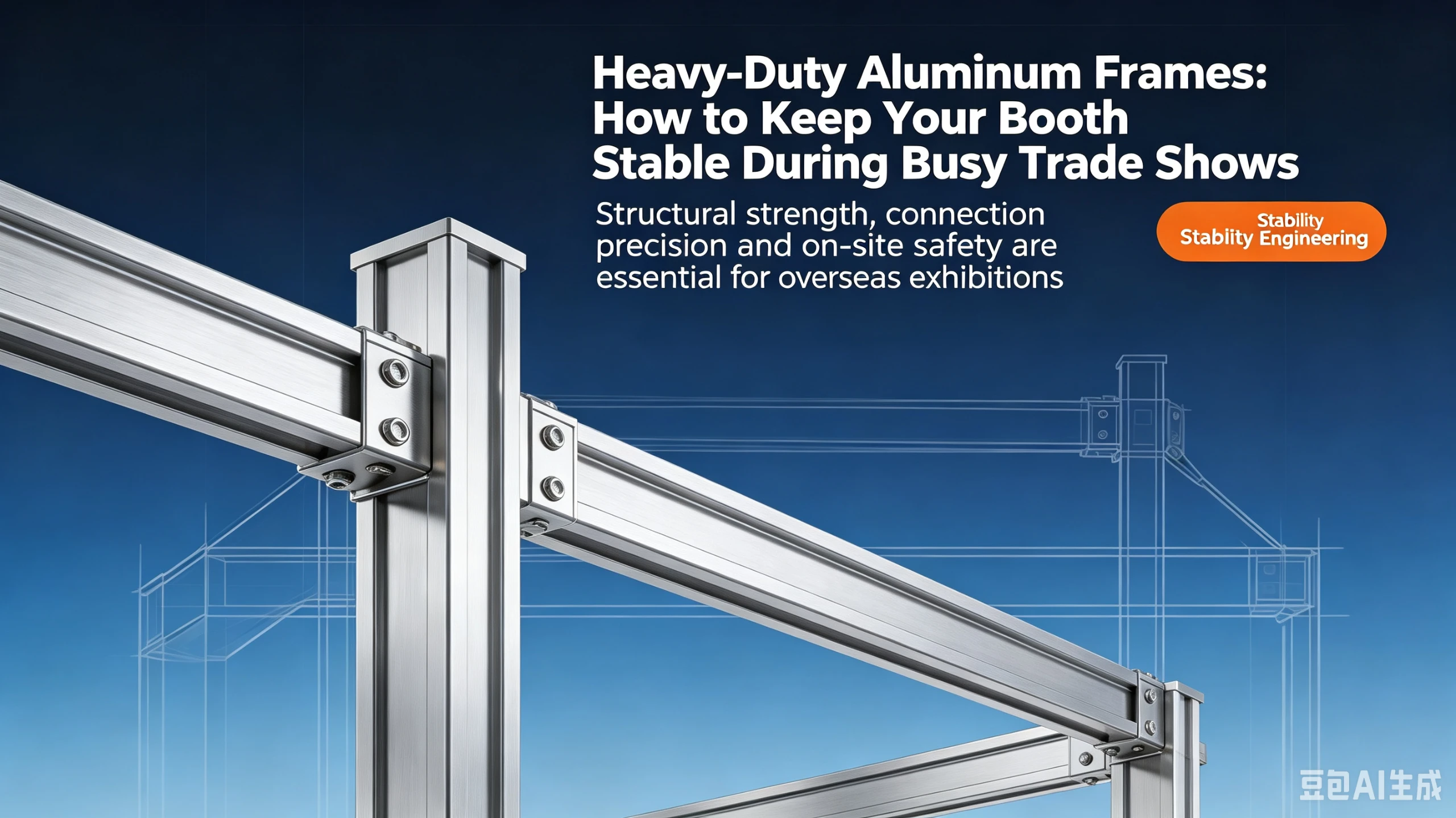
Booth main column uses6063-T5 Anodized Aluminum 80 Series Octagonal ColumnIts octagonal cross-section edges act like built-in reinforcement ribs, enhancing the cross-section'sMoment of InertiaCompared to square tubes, this structure distributes stress more evenly when subjected to lateral forces, offering greater resistance to bending and torsion, thereby enhancingthe strength of the 80 Series aluminum alloy columns.。
How does the three-card quick-lock connector transmit and distribute loads?
The frame's connection relies onaluminum alloy flat bars with three-card quick-lock connectors.。 When locked, the three sets of buckles mechanically engage into the grooves of the flat bar, forming a rigid connection. When an impact occurs at a point on the frame, this design allows the force to be rapidly transmitted through the flat bar to adjacent columns and distributed by the entire structure, preventing the connection points from loosening.
This directly improvesQuick-lock connectors resist impactand maintain continuity with the overall frame.
Anodizing processfurther enhances the surface hardness and corrosion resistance of the aluminum, helping the frame maintain its performance through repeated use. Overall, the octagonal columns improve thebending and torsional resistanceof individual components, while the quick-lock connectors ensure the frame can act as a whole todistribute loadsto jointly maintainthe stability of the heavy-duty aluminum alloy frame。
What stability challenges can this booth frame handle at crowded event venues?
At crowded exhibitions or job fairs, booth frames primarily face challenges such as lateral leaning, minor collisions with objects, and ground vibrations caused by continuous foot traffic. This heavy-duty aluminum alloy frame and its system design are engineered to meet the stability demands of these everyday scenarios.
How does it resist accidental collisions and continuous vibrations?
The frame's octagonal column structure design helps disperse lateral impact forces. Its connection points utilize an 'aluminum flat bar + three-buckle quick-lock connector' system, a professional connection method that ensures rigidity at the joints. When a collision or leaning occurs, the impact force can be dispersed throughout the entire frame system through reliable node connections, thereby reducing localized shaking.
For minor vibrations caused by continuous foot traffic, the sturdy aluminum frame can also effectively block them, preventing the structure from resonating.
Is the method of securing the exhibition panel to the frame reliable?
The coordinated work of the exhibition panel and the frame is key to system stability. Once the exhibition panel is secured using standard methods, it is no longer just a hanging accessory but becomes an integral part of the frame structure, participating together in force transmission. This helps stabilize the center of gravity of the entire structure within the range of the bottom support.
Combined with the stable design of the frame itself, correctly installing the exhibition panel typically does not cause a 'top-heavy' instability issue.
It should be clear that this frame is primarily designed for static or quasi-static loads in vertical and horizontal directions, suitable for conventional foot traffic and material handling scenarios. It can effectively reduce the shaking of modular exhibition booths and ensure safety in high-traffic exhibitions. It is not designed to withstand extreme conditions such as heavy impacts from objects or strong winds.
For organizers prioritizing safety and efficiency, when should a heavy-duty frame be chosen? When should other solutions be considered?
For organizers prioritizing safety and efficiency, when should a heavy-duty frame be chosen?When should other solutions be considered?
When your event has the following characteristics, investing in a heavy-duty aluminum alloy frame is a necessary choice to ensure safety and efficiency:
- Frequent Exhibitions and Repeated Use: As a regular exhibitor, the frame requires repeated assembly, disassembly, and transportation.This frame uses 6063-T5 aluminum and a tool-free quick-release design, with durability that reduces long-term wear and tear and the time and labor costs of each setup.
- Large Events and High Foot TrafficAt large trade shows, recruitment fairs, or brand launch events, booth stability is crucial for brand image and safety.A more robust heavy-duty frame structure can effectively reduce the risk of being accidentally knocked over in crowded environments.
Budget boundaries: When is it unnecessary to pay for this stability?
In the following situations, you may prioritize other options or a more simplified configuration:
- One-time or extremely low-frequency events: If it's just an occasional small internal meeting or a pop-up promotional point, the ultimate stability of the frame is not the primary concern.At this time, you can weigh lighter or one-time low-cost options.
- Extremely tight budget and a controllable environmentIn indoor environments with low foot traffic and infrequent assembly/disassembly (such as hotel conference rooms), the requirement for the frame's heavy-duty load-bearing capacity is reduced.When the core need is extreme low cost or single-use consumption, choosing a simpler solution may be a more reasonable budget allocation.
How to judge the stability parameters of an aluminum alloy frame?Which details affect long-term safety?
When selecting a heavy-duty aluminum alloy frame, the numbers on the parameter sheet directly relate to whether the booth is stable in a crowded exhibition venue and whether it can withstand repeated assembly and disassembly. Understanding these parameters is the first step in judging its long-term safety.
Interpreting Key Parameters: The Significance of Aluminum Alloy Grade, Column Series, and Surface Treatment
First, look at "6063-T5" . This is not just a material code:
- 6063 is an aluminum alloy grade, characterized by good extrudability and corrosion resistance, making it a common choice for structural frames, balancing strength and workability.
- T5 refers to the temper condition, indicating the material has undergone artificial aging.This gives it a medium-to-high strength, ensuring the frame is less prone to deformation when bearing the weight of panels and during daily operations.
Secondly,"80 Series" Refers to an aluminum profile with a cross-sectional width of approximately 80 millimeters. A larger series typically means a thicker wall and a wider support surface. For booths that need to hang multiple artworks, support televisions, or build multi-tiered structures, the 80 Series provides a physical support foundation that is far more reliable than the 60 Series, effectively reducing the risk of wobbling caused by uneven load distribution.
Durability Signals: How Do Certifications and Surface Treatments Reflect Quality?
"Anodizing" is another key indicator of safety and durability. It is by no means just for aesthetics:
- Wear and scratch resistanceDuring frequent transportation, assembly, and disassembly, the anodized layer effectively protects the aluminum body, preventing structural precision and appearance from being affected by surface scratches or wear.
- Enhanced Connection ReliabilityThe uniform and dense oxide layer reduces gaps at connection points (such as between aluminum flat bars and three-card quick locks) caused by friction or minor deformation, helping to maintain a long-term secure state and preventing overall structural instability due to loosening.
Furthermore, the product has passed CE and ISO9001 certifications which serve as important quality endorsements. CE certification indicates that the product meets the basic requirements of the European Union for safety and health;ISO9001 proves that its production process has a stable quality management system. These certifications provide a foundational guarantee for the consistency of aluminum composition and process reliability from the supply chain and manufacturing source.
Next Steps
When consulting on specific plans, you can directly ask us: "For the (describe dimensions and load, e.g., a 3-meter high, double-opening booth needing to hang a 42-inch TV) booth I plan to build, what are the recommended aluminum alloy grade, series, and wall thickness?" " Our technical team will provide you with matching configuration suggestions.
Frequently Asked Questions
Q: What is the difference between the '6063' and '7075' aluminum alloys in the product specifications? Does it have a big impact on my booth? A: Simply put, 6063 aluminum alloy strikes a good balance between strength, toughness, and processing cost, making it a reliable choice for the vast majority of exhibition frames, ensuring stability and cost-effectiveness.
7075 aluminum has higher strength and better fatigue resistance, and is typically used in special industrial scenarios with extreme requirements for load-bearing or impact resistance. For standard exhibition applications, high-quality 6063-T5 aluminum is fully capable of meeting stability and safety requirements.
Q: Regarding the 'anodized' surface treatment you mentioned, if my booth is primarily used indoors, is it less important? A: Even indoors, a booth must withstand heat from lighting, temperature fluctuations from air conditioning, and impacts during setup. The anodized layer can effectively resist surface corrosion and wear caused by these factors, maintaining the tightness of connections over the long term.
Therefore, it remains a crucial process for ensuring the long-term stability and intact appearance of the frame, not just for aesthetics.
Q: What are the specific benefits of using 'three-card quick-lock' connectors? A: Three-card quick-lock is a tool-free, rapid connection method. Its advantages are: 1) The locking force is evenly distributed, avoiding profile deformation caused by excessive force at a single point;2) The structure allows multiple locking points to secure together, enhancing overall rigidity;3) Assembly and disassembly are very convenient, reducing the risk of thread stripping or loosening that may occur from repeated use of ordinary bolts.
This directly relates to the structural stability of the frame after repeated use.
Q: Besides looking at the aluminum parameters, what other methods can be used to intuitively judge the stability of the frame? A: You can focus on two details: 1)The wall thickness of the profile: Within the same series, profiles with thicker walls have better strength and rigidity. 2)Fill at the connection point: Observe or inquire whether the fit between the connector and the aluminum channel is tight and free of wobble.
A tight fill means more direct force transmission and a more integrated structure. When consulting, you are welcome to directly request to see the profile cross-section diagram to understand the wall thickness data.
Learn More
Choosing a truly reliable 'skeleton' for your next exhibition is crucial.If you already have preliminary information on booth dimensions, load-bearing items (such as display panels, TVs, lighting), or the event environment, you are welcome to submit it to us.Our technical team will recommend the most suitable aluminum alloy frame configuration plan based on your specific working conditions.
Related Products:Modular Exhibition Booth Kit, Quick Disassemble Stable Reusable Standard Trade Show Display Stall, Custom Size Octagon A