What exactly are the five components that make up the total cost of ownership of a 10×20ft booth?
For the same 10×20ft booth, the numbers for three options on a quote may differ by several times, but the quote itself is not enough to support a decision. To compare modular systems, custom wood structures, and rentals, costs first need to be broken down into five items.
Why a one-time purchase price cannot represent the true cost
A one-time purchase price only reflects the amount of the first payment; it does not reflect how many times that money is used or how much additional labor and logistics expense is added each time. Custom wood structures are counted as one-time consumption, rentals are billed anew each time, and modular systems are counted as asset depreciation—the three cost occurrence methods are different, so directly comparing unit prices will lead to misleading conclusions.
Five cost items: one-time investment, number of reuses, labor time, transportation and storage, graphic replacement
One-time investment: structural components, connectors, graphic panels, transport crates, and initial design development. Custom wooden structures also involve one-time woodworking fabrication, which essentially goes to zero on the second use;Renting this option is the lowest, but what you get in return is a single-use right.
Reuse count: this is the dividing line among the three options. When deciding, do not ask "which is cheaper," but ask "how many events do I plan to attend in the next 12 to 24 months."
Labor time: setup, dismantling, on-site adjustments, and teardown. The modular system adopts a tool-free connection design, which can reduce on-site reliance on specialized trades.
Transportation and storage: Wooden structures are bulky and easily damaged, making round-trip transportation and warehousing more burdensome;The modular system can be disassembled into standard components, making storage more orderly. The more scattered the exhibition cities, the more obvious the differences become.
Graphic replacement: When brand information is adjusted, wooden structures often involve redoing panels;The tension fabric or panels of the modular system can be replaced individually, while the structure continues to be used.
Looking at these five items together: custom wood structures have concentrated upfront costs and are hardly amortized later;rental occurs each time with no asset accumulation;modular systems have moderate upfront investment and decrease per use as reuse count increases. Which item has the highest proportion needs to be confirmed based on your company's actual number of events and setup conditions.
What is a modular exhibition booth and how does it work: how do tool-free assembly and reusable frames affect costs?
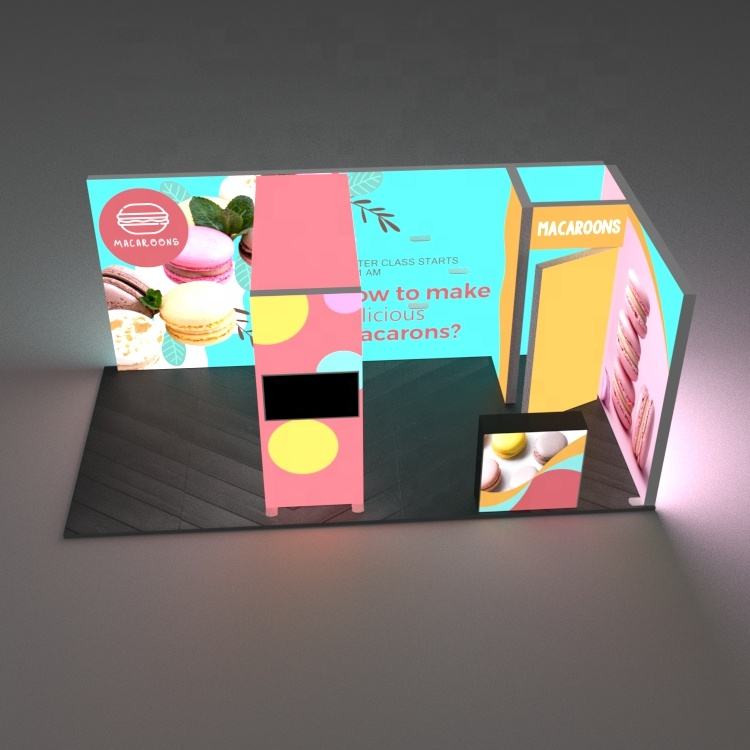
The core of a modular exhibition booth is not "cheapness," but rather using one set of structures repeatedly at different exhibitions. The QSY 10×20ft New-Style Modular Trade Show Booth consists of a high-strength 6063-T5 aluminum alloy frame, dedicated tool-free connectors, and replaceable tension fabric/PVC/LED lightbox graphics. The booth size is 10×20ft, and the height can be customized according to venue restrictions.
Frame, connectors, and assembly method of the QSY 10×20ft modular exhibition booth
The assembly logic is "frame first, panel later": the aluminum profiles are anodized and joined by locking with Z981F zinc shell connectors, without the need for wrenches or screwdrivers, and the graphic is inserted into the frame using tension fabric or PVC panels. On-site setup mainly relies on manual alignment and locking, rather than tools and power equipment. The tool-free design eliminates the steps of finding tools, tightening screws, and repeated calibration, but it does not eliminate all manpower.
For the first setup, it is recommended to allow time for a pre-assembly, and afterward reuse the same numbering and drawings, which will significantly improve on-site speed.
The connectors use engineering reinforced nylon plus aluminum alloy fasteners and are a locking-type structure. Its reliability is based on correct locking and use according to the designed load. If you need to suspend a heavy LED screen or build a multi-level structure, it is recommended to inform the QSY team of the weight, quantity, and load-bearing positions of the suspended items before placing an order to confirm the connection plan, rather than adding them on site temporarily.
How the reusable design spreads the cost across multiple exhibitions
Custom wooden structures are usually a one-time investment and are basically scrapped after the exhibition ends;Rental requires paying a fee each time, and you leave once you are done using it. The cost structure of a modular exhibition stand is different: the first investment includes the frame, connectors, and the first batch of graphics, and after that each exhibition mainly adds graphic updates, transportation, and labor. The more times you exhibit, the more thinly the cost of the frame portion is spread.
To judge whether it is cost-effective, the key is the number of exhibitions per year and the frequency of graphic replacement at each show—only when the number of shows is stable and the brand visual continuity is strong can the reuse value of a reusable exhibition stand be reflected.
Where do the costs of custom wooden structures and rental occur: why are they not the same kind of account as modular?
To judge the total cost of ownership of a 10×20ft exhibition stand, you first need to see clearly which stage the money is spent on. Custom wooden structures and rental are quoted differently, but their costs are both concentrated on a “single exhibition;”Modular systems, on the other hand, put the investment into reusable structures.
Custom wood structures: one-time fabrication, on-site construction, and non-reusability
The cost of custom wood structures is concentrated in three areas: fabricating irregular components according to drawings, on-site carpentry and painting work, and post-exhibition dismantling and removal. Wood components are cut and assembled according to the shape of that specific event, and after dismantling they usually cannot be restored into parts that can be used again, making it difficult to allocate fabrication costs and on-site construction costs to subsequent exhibitions. The more exhibitions you participate in, the more the cumulative expenditure approaches the single-event cost multiplied by the number of events.
It is more suitable for occasions with high styling requirements and low exhibition frequency.
Rental: single-service fee, setup labor, and graphic limitations
Rental costs are incurred per event: single-service fee, setup and dismantling labor, and the production and replacement of graphic images. The structure is not owned by the exhibitor, and service fees and labor must be paid again for each show. Graphics and layouts are also limited by the rental provider's inventory, and standard graphic sizes and installation methods are often fixed. Brand visuals need to accommodate the ready-made structure, and changing artwork or sizes may incur additional fees.
As exhibition frequency increases, per-show costs continue to accumulate, and the total cost may exceed that of a one-time investment in a modular system.
Modular system: costs go into a reusable structure
The cost structure of the QSY modular booth is different: the frame uses high-strength 6063-T5 aluminum alloy with tool-free connectors, and assembly and disassembly do not rely on carpentry and painting processes, so the structure can be reused across multiple exhibitions. Production and setup investment can therefore be spread across multiple uses. Graphics use dye-sublimation full-color custom printing, and the visuals can be replaced according to brand needs without having to accommodate fixed sizes.
Which approach is more cost-effective depends on the number of exhibitions per year, the degree of custom styling, and whether you are willing to put budget into a structure that can be held for the long term.
When modular booths are recommended and when they are not: conclusions based on exhibition frequency and on-site conditions
Whether a modular booth is cost-effective depends first on annual exhibition frequency and second on on-site conditions. The following gives the boundaries for recommendation and non-recommendation based on these two factors.
Three scenarios where modularity is recommended: exhibiting multiple times, tight labor, and graphics that need frequent replacement
Exhibiting more than twice a year. The frame of a modular system can be repeatedly disassembled and reassembled, while the graphic parts are replaced separately. The higher the exhibition frequency, the more fully the initial investment is amortized, and the closer the per-show allocated cost is to rental, while the booth form and brand consistency remain under your own control.
On-site manpower is tight and the setup window is short. Tool-free quick-lock assembly reduces reliance on professional carpentry and power tools, cutting labor hours for setup and teardown. For exhibitors without a fixed build crew, this factor often affects decisions more than material price differences.
Graphics need to be changed frequently. Fabric tension panels or PVC panels can be reprinted independently of the frame, so there is no need to alter the structure when changing themes or product lines. If visuals are updated more than once a year, the marginal cost of modularity is lower than rebuilding a wooden structure.
Scenarios not recommended or requiring caution: one-time exhibitions, venues with height restrictions, and no storage conditions
Exhibiting only once and not planning to reuse. For one-time use, the structural investment in modularity cannot be amortized, and renting or building on demand is more cost-effective.
Venue height restrictions are strict. Modular systems can achieve relatively tall build heights, but the specific height that can be assembled depends on the venue's clear height, rigging point rules, and fire safety requirements. When height restrictions are tight, first confirm the venue's upper limit, then decide on the structural form.
No storage or transportation conditions. For modular systems to be reused, space is needed for stacking frames, panels, and accessories, as well as reusable transport crates. If the company has no warehouse and is unwilling to bear round-trip logistics, the advantages of reuse will be offset.
Budget boundaries and tradeoffs
Break the decision into two accounts: one-time expenditure (structure + first batch of graphics) and per-event expenditure (transportation + labor + graphic updates). If you exhibit only a few times, the first cost calculation dominates, and renting or a wooden structure is more suitable;If you exhibit many times, the second cost calculation dominates, and modular construction is more suitable. Custom wooden structures may offer greater visual freedom, but they have low reusability and are suitable for one-time, high-budget projects.
Frequently Asked Questions
Q: We exhibit three times a year, but the booth size is different each time. Is modular construction still suitable? It is necessary to confirm whether the frame can be reassembled in different sizes. QSY supports straight and curved frames and custom sizes, but whether the same set of profiles can be shared across your several booth specifications requires providing the size list to the team for a matching assessment.
Q: How tall can a modular booth be built? The height is determined based on customization requirements, while also constrained by the exhibition hall's clear height and fire safety regulations. Provide your venue's height limit data, and the team will give a corresponding solution.
Q: Can the graphics be changed only by replacing the visuals without changing the frame? Yes. Graphic materials support options such as fabric tension cloth, PVC panels, and LED light boxes. The visuals can be independently reprinted while the frame continues to be used.
Q: If I don't have a warehouse, can I just rent instead of buying? This depends on your usage rhythm. If you only exhibit occasionally, the rental path is lighter;If you plan to use it for multiple consecutive events, you can explain the storage conditions to the team and evaluate together whether purchasing or renting is a better fit.
Learn more
If you are budgeting for the next round of exhibitions, you might want to compile the number of exhibitions per year, the height limits and rigging point conditions of the venues you frequently visit, and your existing warehousing and transportation methods. The QSY team can use this to help you break down the one-time investment and the per-event expenses separately, and determine whether a 10×20ft modular exhibition stand is a better fit for your pace than a custom wooden structure or renting.