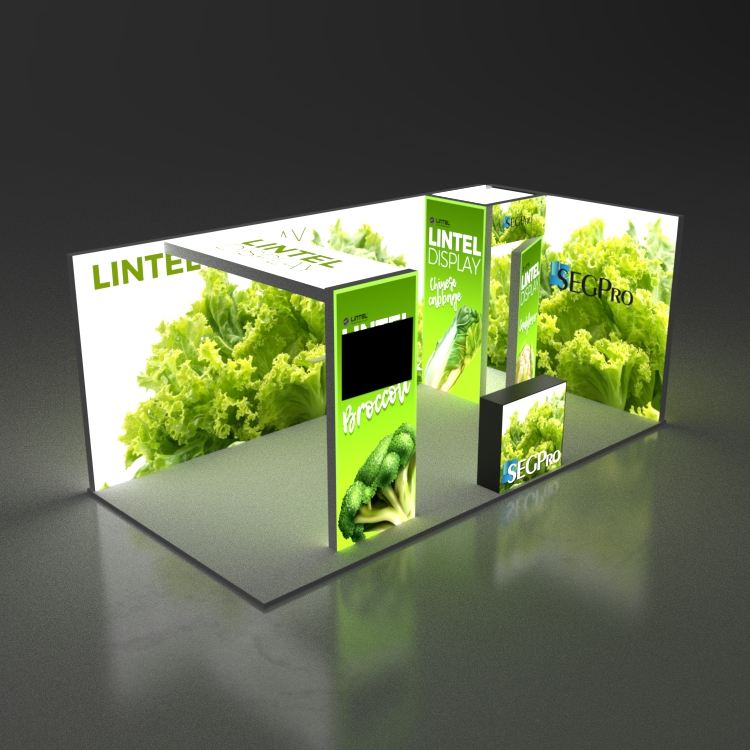
After the 3×3m SEG light box booth is disassembled, why are the aluminum alloy tubes the parts most vulnerable to bumps and impacts?
When dismantling the booth, rolling up the canvas and packing the light strips into the box are not difficult. What really determines whether the booth can be used again next time is often those few aluminum alloy tubes—they look sturdy, but in reality they are the parts least able to withstand the wear and tear of transportation.
Transportation risks of aluminum alloy tubes: deformation and connector damage
The advantage of aluminum alloy is that it is lightweight; the trade-off is limited wall thickness. The tubes for a 3×3m booth are usually slender. Once they are not properly secured inside the box, the jolting during transportation will cause the tubes to collide with each other, be crushed by heavy objects, or slide out of the box opening and hit hard ground. Problems are concentrated in two places:
- The tube body bends or dents. Slender tube fittings are prone to bending that is difficult to detect with the naked eye when subjected to force.When you put it back together, you will find that the frame does not align, the canvas cannot be stretched flat, and wrinkles or dark areas appear on the lightbox surface—this is not a problem with the canvas, but rather the tube fittings have already deformed.
- Damage to interfaces and connectors. The two ends of the tube fittings are the key parts for splicing. After being bumped, deformed interfaces, burrs, and failed buckles will directly cause them to not fit in or lock tightly during assembly.This type of damage is more troublesome than bending of the tube body, because it often cannot be repaired on site.
In other words, tube fittings are not afraid of being "used"; what they fear is being "placed carelessly." If the canvas is damaged, it can be remade, but if the tube fitting interfaces are damaged, the assembly precision of the entire frame is lost.
The core principles for packing tube fittings: wrap them independently and secure both ends.
Packing does not require complex materials, but you need to focus on two actions:
- Wrap each pipe fitting individually. Use bubble wrap or a soft protective sleeve to wrap the pipe body, avoiding direct metal-to-metal contact between fittings.When multiple pipe fittings are in the same box, add dividers in between so they do not rub against each other.
- Reinforce both ends with extra focus. Interfaces and connectors are the priority protection targets. Add extra-thick wrapping or protective caps to the ends, then secure the pipe fittings inside the box with foam and straps to limit movement forward, backward, left, and right.If pipe fittings can move inside the box, they will definitely get bumped.
If your booth needs to travel to exhibitions multiple times, it is recommended to secure them this way during the first packing and remember the position of each pipe fitting. The quantity of pipe fittings, lengths, and connector types vary depending on the booth configuration. For how to divide your 3×3m booth into boxes and what protective pieces are needed, you can directly ask the QingSuYv team, and they will provide a packing plan based on your actual configuration.
PVC display fabric and LED strip power supplies: which is more susceptible to pressure, and which is more susceptible to moisture?
The "vulnerabilities" of these two types of components are completely different: what PVC display fabric fears isfolding creases and stains, while what LED strips and power supplies fear ismoisture and hidden compression. If the same packing logic is applied during packing, it is very easy to crush the display on one hand while creating electrical hazards on the other.
Display fabric: folding creases and stains are the main risks
PVC graphic cloth itself has a certain degree of flexibility, and normal rolling and transportation will not damage it. What really causes problems are two kinds of handling:
- Hard folding: folding the graphic cloth in half or at multiple corners to fit it into a small box will leave obvious white marks at the fold lines. Once it is installed on a light box and backlit, the creases are even more noticeable than when viewed from the front.
- Heavy pressure: placing the graphic cloth flat on the bottom of a box and stacking aluminum profiles or power supply boxes on top of it will, over time, press in dead folds that may not fully recover after being unfolded.
Stains are equally troublesome. Once the PVC surface is stained with oil or dark dirt, wiping it on site with an ordinary damp cloth often does not clean it thoroughly, and the graphic cloth cannot be casually cleaned with solvents. So the key points for protecting the graphic cloth are:Roll it up, don't fold it, don't press it, and protect the outer layer from dirt。
As for whether it can recover after being folded—the slight curvature left by gentle rolling usually flattens out naturally once unrolled;but for graphic cloth that has already formed sharp creases or hard-set folds, it is very difficult to completely eliminate them by hanging and backlighting. This is also why, when packing, it is better to use an extra tube than to force-fold it just to save space.
LED strips and power supplies: moisture and compression are more hidden than impacts
LED strips and power supplies are electrical components, and what they fear most during transport is not "a drop," but two types of invisible damage:
- Moisture: After the power supply is exposed to moisture internally, its appearance may be completely normal, but abnormalities may occur when it is powered on.Humidity at the exhibition site, rain during transportation, and warehouse environments can all introduce water vapor.The connection between the power supply and the light strip is especially vulnerable to moisture.
- Compression: If the light strip is pressed by heavy objects or the power supply box is squeezed by aluminum profiles, internal components or solder joints may be damaged.This kind of damage also does not appear immediately; the problem is only discovered after power is turned on, leaving almost no time for remediation on site.
Therefore, the key protection points for light strips and power supplies are:Independent packaging, moisture protection, and avoiding mixed compression with heavy items. For the power supply, it is recommended to pack it separately in a moisture-proof bag or a cushioned box. After coiling the light strip, secure it, and do not stack it directly on the same layer as heavy items such as aluminum profiles and bases, where they may press against each other.
A simple classification judgment
| Component | Primary risk | Secondary risk | Packing orientation |
| PVC graphic cloth | Folding creases, stains | Long-term heavy pressure | Winding, stain-resistant, no folding |
| Light strip | Moisture, connector compression | Pulling | Wound and secured, moisture-proof |
| Power supply | Moisture, heavy object compression | Impact damage | Independent cushioning, moisture-proof, no mixed stacking |
If your booth is a 3×3m specification and the graphic fabric is relatively large, the graphic fabric usually needs to be packed separately in a long cylindrical tube, which will directly affect the overall dimensions of the transport case and the vehicle loading method. Specifically regarding the graphic fabric dimensions of this QingSuYv booth set, the interface types for the light strips and power supply, and packaging recommendations, it is advisable to inform the team of your transport method (express delivery, dedicated line, or self-delivery) and whether you need multiple round trips to exhibitions before confirming the order, so that a more reliable packing solution can be matched.
How to arrange the packing order: what to load first, what to load later, and what goes in each layer?
The components of a 3×3m light box booth differ in their resistance to pressure, bending, and scratching. The core logic of the packing order is:The heaviest and hardest components go at the bottom to bear the weight, while the lightest and most bend-prone components float on top or are isolated separately.
Layered packing order: from heavy to light, from hard to soft
First layer (bottom of the box): aluminum alloy pipes. Aluminum pipes are strong but prone to scratches and deformation at the pipe ends. First wrap them with bubble wrap, add protective sleeves to the pipe ends, bundle them in groups by length, and lay them flat at the bottom of the box. Place the longest pipes at the very bottom and fill the gaps with shorter pipes. This layer also bears the load of the entire box.
Second layer: graphic fabric. Roll it up with a hard cardboard tube or PVC pipe as the core, wrap a layer of soft cloth on the outside, and lay it flat above the pipes. The graphic fabric is prone to creases and damage from sharp objects. Do not let it come into direct contact with the pipes, and do not stack multiple sheets on top of each other.
Third layer (top layer or side): LED strip power supply. The power supply is susceptible to moisture and pressure. Wrap it separately in an independent moisture-proof bag or bubble wrap, then place it on the top layer or side, with extra protection at the connectors. Do not mix with pipe fittings to avoid stress on the joints during transportation.
In-box securing and cushioning: prevent secondary impacts during transportation
Layering is only the first step; the key isthere must be no room for movement between layers。 After loading each layer, press down with your hand to check. If a component can slide, add foam blocks or air bags to fill the gaps. The four corners of the box are the most vulnerable to impact. It is recommended to add corner protectors or thick foam on the inside of the four corners.
After the box lid is closed, there should be no downward pressure; otherwise, the top-layer components may be dented. The outside can be marked with "This Side Up" and "Fragile" labels, but internal cushioning is the fundamental solution. If multiple boxes are shipped for the same batch of booths, it is recommended to write the packing order into the instruction card included with the boxes—disassembly, assembly, and transportation are often not handled by the same group of people, and a clear order card can reduce on-site rework.
In which situations is it recommended to prepare an extra set of accessories, and in which situations is it not worth adding complexity?
Spare parts are not safer the more there are. For spare parts decisions for the disassembly, assembly, and transportation of a 3×3m light box booth, the core depends on two things:Whether a failure can be quickly remedied on site, andhow many times this booth will be reused。
Situations where spare parts are recommended: multiple reuses, overseas transportation, poor on-site remediation conditions
- The same booth setup runs multiple exhibitions in a year: repeated disassembly and assembly, packing, and long-distance transportation mean connectors and LED strips are most prone to problems during loading and unloading.Preparing a set of spare connectors and backup LED strips is more controllable than finding temporary alternatives on-site for a single show.
- Overseas shipping or cross-border exhibition participation: if parts are missing after the goods arrive at the port, locally sourced aluminum profiles or LED strips of the same specifications often do not match the hole positions and voltage, and the reshipment cycle is long.The cost of spare parts is usually lower than the cost of on-site downtime.
- No on-site setup service provider, installing with your own team: when there are no external workers as a fallback, preparing extra connectors, backup LED strips, and a small number of graphic snap strips allows you to handle missing parts on the spot when they are discovered.
Situations where excessive spare parts are not recommended: single-event use, with local alternatives available
- Single-event use, resold or scrapped after use: Spare parts are most likely unnecessary, adding only procurement costs and shipping weight.
- Reliable local builders or suppliers are available: When common parts can be bought or borrowed on site, the priority of spare parts decreases, and it is more cost-effective to spend money on the visuals and structure itself.
- Only domestic short-distance transport, and the team has setup experience: The probability of transport damage is low; a standard set of connectors is sufficient, and a full backup set is unnecessary.
Spare parts priority order
Sorted by the degree to which "if it breaks, it can't be assembled":Connectors/Latches > LED Strips & Power > Graphic Fabric。 The aluminum profile itself has high strength and is usually not a primary spare part;LED strips and power supplies are powered components, and their failure rate is relatively higher after long-term use, so they are worth prioritizing for backup.
Specifically for the QSY-BX BOX Booth, which parts can be replenished individually and how long the replenishment cycle takes need to be confirmed with the supplier based on the transportation route and exhibition duration.
Frequently Asked Questions
Q: If I'm only exhibiting once, do I still need spare parts? A: A full set of spare parts is usually not needed. It is recommended to at least confirm whether the number of connectors is sufficient, and whether the supplier can quickly send a single component before the exhibition.
Q: Which spare parts should be prioritized for booth backup? A: Prioritize connectors and light strips/power supplies, followed by graphic fabric. Aluminum profiles and frames are generally not the primary spare parts.
Q: For overseas exhibitions, how should SEG light box spare parts and shipping costs be weighed? A: Overseas replacement parts have long lead times and specifications are difficult to match, so spare parts are usually more worthwhile than the shipping costs saved. The specific amount to bring depends on the length of the exhibition and whether there is local setup support.
Q: During light box booth maintenance, is it necessary to prepare an extra set of graphics? A: If the graphics are custom-made and the reprint lead time is long, it is advisable to confirm the turnaround time for reorders;If the exhibition schedule is tight and the graphics are prone to damage, consider keeping an extra set.
Learn more
If you are evaluating transportation solutions and spare parts configurations for a 3×3m SEG lightbox booth for multiple exhibitions, you can send us your transportation method (express/custom line/drop-off), estimated number of exhibitions per year, and destination cities. The Qingsu Yu team will work with your actual usage rhythm to help you sort out a packaging plan and spare parts list.