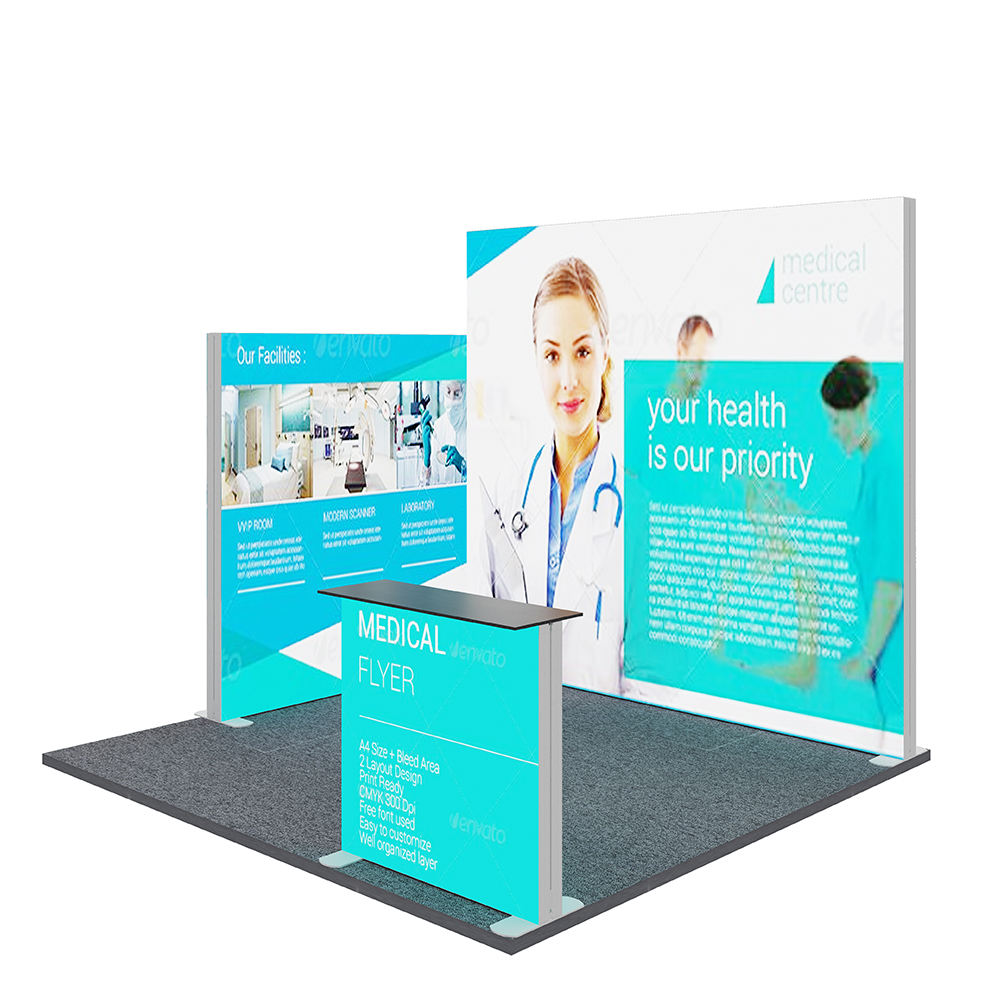
What exactly is a 3×3m light box frame: why it can be reused across scenarios
QingSuYv QSY-BX BOX Booth is a modular SEG light box booth. Its basic composition is: aluminum alloy tubes assembled into a frame, with UL94 V-0 flame-retardant PVC and SEG graphic fabric on the outside, and LED backlight modules installed inside, with an overall thickness of 120mm. The standard 3×3m size fits a 10×10ft inline booth, with a maximum height of 2.5m and a customizable width of 1–6m.
How the SEG light box frame works: aluminum alloy tubes + graphic fabric + LED backlight
SEG means the silicone strip on the edge of the graphic fabric is inserted into the frame groove; once tensioned, it is flat and wrinkle-free, and the LED backlight shines through evenly from behind. The frame tubes are connected by plug-in or snap-fit connections, requiring no screwdriver, wrench, or power tools. One person can complete the assembly by connecting the parts in sequence, installing the light strips, and tensioning the graphic, which is the practical meaning of “tool-free setup.”
Why is "unchanging frame, swappable graphics" the prerequisite for cross-scenario reuse?
The key to this structure lies in: the frame is a standard component, while the graphics are a consumable. After the exhibition ends, remove the graphic fabric and roll it up, and disassemble the frame into tubes and pack them into bags;For the next event, replace it with a new set of graphics, and the frame continues to be used. The same 3×3m frame serves as a backlit display wall at exhibitions, a product backdrop in shop windows, a key visual in pop-up stores, and a brand pillar in shopping mall atriums—only the graphic content and placement method change.
The prerequisite for cross-scenario reuse is to confirm three things at the time of first purchase: whether the frame connectors support repeated disassembly and assembly without loosening;whether the graphic fabric can be completely peeled off the frame and replaced separately;whether the LED modules are easy to maintain or replace individually. These three points determine whether it is a "one-time booth" or a "transferable modular asset."
Exhibition scenario: How to use a 3×3m light box booth in a 10×10ft inline booth
10×10ft (approximately 3×3m) is the most common inline standard booth in European and American exhibition halls, with three enclosed sides and one open side. A 3×3m light box booth just fills this space, but "fitting in" and "using well" are two different things—the key lies in how you allocate these 9㎡.
Reception counter + double-sided light column: Complete brand display and customer reception simultaneously within 9㎡
The typical configuration of a complete combination is: one main background light box wall handles the primary brand visual, one side extends out a reception counter for customer lingering and material exchange, and on the other side or at the corner stands a double-sided light column, allowing brand visuals to be seen from both aisle directions.
This layout solves the most common contradiction of inline booths: the background wall can only speak in one direction, while visitors may approach from the left or right sides. The double-sided light column adds side exposure, while the reception counter turns "passing by" into "stopping."
A trade-off to note: the reception desk will occupy about 1-1.5㎡ of standing and conversation space. If your booth needs to accommodate more than 3 people for discussions at the same time, it is recommended to place the reception desk near the main aisle side rather than cramming it into a corner.
Prerequisites for completing tool-free setup within 30 minutes
"Tool-free" means the frame connections do not require a screwdriver or wrench, but there are several prerequisites for completing setup in 30 minutes:
- The graphics are installed in advance: SEG fabric graphics need to be embedded before departure or the day before setup, and on site only frame assembly and graphic hanging are done.
- At least two people working together: When standing up the light posts and backdrop, a single person can easily tip them over, so two people is the minimum configuration.
- The floor is level: Uneven carpet or floor in the exhibition hall can affect the precision of frame alignment. Before assembling, first confirm that the ground has no obvious undulations.
- Confirm the power supply location: Light boxes require power. Confirm the location of the booth's power outlet in advance to avoid discovering the cable is not long enough after the frame is assembled.
If the above conditions are not met, the setup time will be significantly extended. This is not a product issue; it is an on-site preparation issue.
Exhibition hall compliance: three things you need to confirm in advance
When light box booths enter European and American exhibition halls, it is usually necessary to confirm:
- Flame retardant requirements: The frame uses UL94 V-0 flame-retardant PVC, which is a mandatory requirement for lightbox materials in most exhibition halls.Material certification may need to be provided upon entry.
- Electricity Declaration: Lightboxes are electrical equipment, and some exhibition halls require advance declaration of power consumption and payment of electricity fees.
- Height Restrictions: Inline booths usually have a height limit (commonly 2.5m or the value specified by the exhibition hall). The maximum height of a lightbox booth is 2.5m, and it is necessary to confirm whether it is within the range allowed by the exhibition hall.
It is recommended to confirm these three items with the exhibition hall or organizer 2-3 weeks before the exhibition, rather than waiting until the day of setup.
Who It Is Suitable For, Who It Is Not Suitable For
Suitable for: small brands with limited budgets but needing brand recognition, teams exhibiting for the first time who want to control setup complexity, and operators planning to reuse the same framework for multiple exhibitions.
Not suitable for: booths requiring large-area product displays, scenarios requiring independent meeting rooms, and irregular booths with unclear opening directions or extremely narrow aisles.
If you are unsure whether your booth's opening direction and power locations match this combination, it is recommended to send your booth floor plan to the Qingsu Yu team so they can help you confirm the placement direction of the reception desk and light columns.
Window displays, pop-ups, and shopping mall atriums: what needs to be adjusted for the same framework
Switching from exhibitions to window displays, pop-ups, and shopping mall atriums, the main framework, light strips, and graphic system remain unchanged; what changes is theinstallation conditionsandon-site constraints。
Window display scenario: requirements of 120mm thickness on depth and fixing
120mm is the overall thickness of the completed light box, not the cross-sectional dimension of a single profile. This means that this space needs to be reserved behind the graphic, while also considering heat dissipation from the light strip and a concealed location for the power adapter.
Window displays usually have limited depth, so the order of assessment should be:
- First measure the clear depth: deduct the distance from the inner side of the glass to the back wall, then subtract the 120mm light box thickness, and check whether the remaining space is enough for routing cables and placing the power supply.
- Next, check the fixing surface: Mall display windows often do not allow drilling into the glass or floor, so the frame needs to be fixed by its own weight or by pressing down from the top.If the display window is transparent glass on all four sides and there is no wall behind it, the stability of this frame requires additional counterweights or a cable-stayed solution.
- Finally, confirm the power location: Whether the outlet is inside or outside the display window determines whether the power cord is run exposed or concealed, and it also affects the position of the openings in the graphic.
If the display window depth is less than 120mm plus wiring space, or if no fixing parts are allowed on site, whether this frame can be used and how it should be used requires sending photos and dimensions of the display window to the Qingsu Yu team to confirm a suitable solution.
Pop-ups and mall atriums: entry and exit time windows and graphic replacement
The typical constraints of pop-ups and mall atriums are: the entry window may be only a few hours, the exit is equally tight, and the graphic content may be replaced midway.
This frame system assembles without tools; a standard 1×2m light box requires no tools. A 3×3m booth includes a reception counter and double-sided light columns, with more parts, but the assembly logic is the same. What really affects the speed of move-in is not the frame itself, butwhether the graphic is pre-installed。
SEG graphics need to be inserted before or at the same time as the frame is stood up. If the graphic is installed for the first time on site, the time will be significantly extended.
The practical benefit of using double-sided light columns in a shopping mall atrium is shown here: people flow through the atrium from multiple directions, and double-sided graphics allow brand information to be seen from both sides, without adding another set of single-sided frames just for orientation. For pop-up stores, this means the same footprint can cover more viewing angles.
In terms of graphic replacement, the SEG structure supports replacing the fabric separately without dismantling the frame. If you need to change to a different graphic during the pop-up period, just confirm in advance whether the new graphic is made to the same frame dimensions.
Before switching to a new scene, confirm these three things first
- Clear site dimensions and fixed constraints: depth, ceiling height, whether drilling is allowed, and whether counterweights can be used.
- Power location and wattage: where the outlets are, whether extension cords are needed, and whether the mall restricts power usage hours.
- Graphic production time: whether the graphic for the new scene has already been made to the frame dimensions, or whether it needs to be installed on site for the first time.
If any one of these three items is unclear, it will directly affect whether this framework can be used and whether accessories need to be added. Communicating the site conditions and time window to the Qingsu Yu team in advance is less troublesome than making on-site fixes afterward.
Which situations are suitable for purchase and which are not recommended: the selection boundaries of the 3×3m light box framework
The core value of this 3×3m light box framework is that one structure covers multiple scenarios: the 3×3m compact layout fits standard booths, integrates a reception desk and double-sided graphic pillars, and the framework can be reused while the graphics can be replaced. But it is not a solution that every team should adopt.
Who it is recommended for: brands and builders with multiple annual exhibitions + multi-scenario reuse
If you meet most of the following conditions, this 3×3m light box framework is worth prioritizing:
- The number of annual exhibition appearances is enough to amortize the cost of self-purchaseAttend multiple exhibitions a year; the frame can be reused across shows, and the structure cost per show decreases as the number of shows increases.
- Need to reuse the same image outside of exhibitions. Scenarios such as window displays, pop-ups, and shopping mall atriums can share the frame, unifying the brand image while amortizing the investment.
- Graphic content is changed per exhibition, rather than undergoing major changes each time. SEG fabric graphics can be replaced, but remaking them involves lead time and cost; only when the graphics remain relatively stable can the reuse advantage be preserved.
- Have basic storage and transportation conditions. The frame, light strips, and rolled-up fabric graphics require a dry, flat storage space, as well as a packaging solution for cross-exhibition transportation.
- Have basic on-site installation manpowerTool-free assembly lowers the barrier, but the required number of people and aisle conditions still need to be confirmed according to the configuration.
Who it is not recommended for: teams whose venue compliance has not been confirmed, whose graphic content changes frequently, and who do not have storage conditions.
In the following situations, it is advisable not to purchase yet, or to switch to a simpler solution:
- Venue flame-retardant and electrical requirements have not been confirmed.。The frame uses UL94 V-0 flame-retardant PVC, but this does not mean it automatically satisfies the admission review of all venues.Before confirming item by item with the organizer, the purchasing decision lacks a key prerequisite.
- Graphic content changes substantially for each show and there are no stable design resources.. SEG fabric needs to be remade, and the structural cost saved by reusing the frame will be offset by the graphic cost.
- No warehousing conditions. If you have to temporarily rent storage or discard it every time, the logic of reusing the lightbox booth does not hold.
- No on-site manpower of two or more people for setup. Tool-free does not mean completely hands-free; insufficient manpower will directly affect the efficiency of entry.
- Window depth less than 120mm and cannot be secured. The frame thickness has requirements for installation space; when the depth and fixing conditions are not met, it is not recommended to choose it.
How to choose in the end: conclusion boundaries
The judgment criterion comes down to one sentence: is the complexity of this frame offset by your usage frequency and number of scenarios?
- Multiple trade shows + reuse across multiple scenarios + warehousing and setup manpower available → worth investing in.
- Compliance not yet confirmed / graphics change frequently / no warehousing / no setup manpower → hold off for now, or choose a simpler solution.
Budget decisions should be based on total cost of ownership rather than the one-time purchase price, covering the initial purchase of the frame and graphics, cross-show transportation packaging, graphic replacement production, on-site setup labor, and spare parts inventory. All amounts need to be filled in by buyers according to their own circumstances; this article does not provide specific figures.
If your situation falls in the middle ground, it is recommended that you first confirm two things with the Qingsu Yu team: the entry requirements of the target exhibition hall, and the actual cost and turnaround time for graphic replacement. Once these two conditions are confirmed, the boundaries for choosing a 3×3m light box frame become clear.
Frequently Asked Questions
Q1: If I only attend one or two trade shows a year, is it still worth buying this 3×3m light box frame myself? When the number of events is small, the dilution effect of a self-purchased frame is limited. It is recommended to first compare the local builder's rental quote with the total cost of ownership of self-purchasing, and then decide whether it is worth adding reuse complexity.
Q2: The exhibition hall says flame-retardant materials must comply with local standards. Can this frame meet that requirement? The frame uses UL94 V-0 flame-retardant PVC, but different exhibition halls have different compliance requirements. It is recommended to provide the specific standards of the target exhibition hall to the Qingsu Yu team to confirm whether they match.
Q3: If the graphic content needs major changes for every event, is purchasing an SEG light box booth still cost-effective? If the graphics are greatly changed for every event, the SEG fabric needs to be remade, and the structural cost saved by reusing the frame will be offset by the graphic cost. It is recommended to first calculate the total annual cost of graphic replacement, and then judge whether it is cost-effective.
Q4: Does tool-free assembly really require no tools or multiple people? Product information indicates tool-free assembly, and the assembly time for a standard 1×2m light box is within 30 minutes. The actual assembly time for a 3×3m booth will vary depending on the configuration and proficiency level. It is recommended to confirm the assembly process and required number of people for the specific configuration with the Qingsuyu team.
Q5: If there is no storage space, can this solution still be used? The frame and graphics require storage space. If warehouse space must be rented temporarily each time, the logic of reusing the light box booth does not hold. It is recommended to solve the storage issue first before purchasing.
Learn more
If you are evaluating whether a 3×3m light box booth can simultaneously cover exhibitions, window displays, and pop-up scenarios, you can send your annual exhibition plan, target venue conditions, and graphic replacement frequency to the Qingsuyu team.Based on your actual working conditions, we will help you determine whether this framework is a match, as well as which site and compliance information needs to be confirmed in advance.