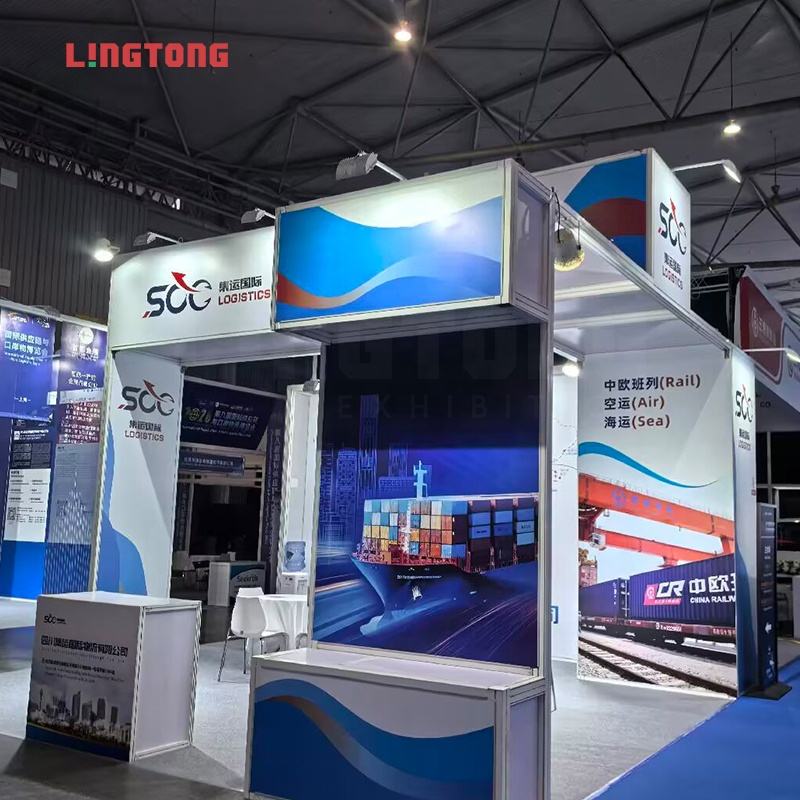
What exactly does modular booth customization mean? First, distinguish three levels.
Many small and medium-sized enterprises that encounter modular booths for the first time tend to fall into two extremes: either they think "modular" means fixed sizes and only ready-made packages to choose from;or they think "customization" means hiring a designer to draw from scratch and re-create molds. In fact, the customization capability of modular booths falls into three completely different levels. Understanding them will help you know which one you actually need.
Size customization: from standard modules to non-standard combinations.
Size customization is the most basic and most easily misunderstood level of modular booths.
It does not involve redesigning the structure, but rather adapting to your booth area through the arrangement and combination of standard modules. For example, a standard 3×3 meter booth and a 4×6 meter custom booth use the same aluminum alloy truss modules, differing only in the number of modules assembled and the connection method. This is what "non-standard combination" means—the modules are standard, but the overall dimensions of the combination are non-standard.
It is important to note that size customization has its limits. It typically means that the booth's floor plan dimensions (length and width) and height can be adjusted within a certain range, rather than any arbitrary shape being achievable. Special shapes such as curves, irregular forms, and cantilevered structures require additional confirmation of the structural solution.
If you have such needs, it is recommended to directly specify the booth dimensions and desired shape during consultation, allowing the team to assess whether existing modules can cover them.
Layout and Brand Graphics: Customization Does Not Mean Redesign
Layout customization refers to the functional zoning inside the booth—where the reception desk goes, how the product display area is enclosed, how many seats the meeting area needs, and how wide the aisles should be. These can be achieved by adjusting the placement direction and connection positions of the modules, without the need to redesign the structure. For exhibitors, the value of this step lies in the fact that with the same booth area, different layouts result in completely different visitor traffic patterns and negotiation experiences.
Brand graphic customization is another matter. It does not change the booth structure, but instead prints the brand visuals onto the booth. There are usually two specific implementation methods: one is to directly print the brand graphics onto the panels or backboards of the booth;the other is to fix independent graphic carriers (such as lightbox films, spray-painted cloth, or magnetic graphics) onto the truss structure.
The former provides a more integrated visual, while the latter offers more flexibility for replacement, making it suitable for situations where the same booth is used repeatedly across multiple exhibitions with different themes each time.
Here, a common misconception should be clarified: brand graphic customization does not mean redesigning the booth. You don't need to redesign the structure for every exhibition; you only need to update the visual content. This is also where modular booths show the most obvious cost advantage in long-term use—the structure is a one-time investment, while the visuals are a variable cost for each exhibition.
Three levels, corresponding to three types of decisions
| Customization level | Specific content | Effort required |
|---|---|---|
| Size customization | Booth length, width, and height are adjusted through module combinations | Low, just confirm the dimensions |
| Layout customization | Functional zoning, traffic flow, reception and display positions | Medium, the exhibition process needs to be clarified |
| Brand graphic customization | Visual content, printing method, replacement frequency | Medium, design files need to be prepared |
For your next step, the key is not to ask "can it be customized," but to clarify: which level of customization do you need? If this is your first exhibition and the booth area has not been finalized yet, first confirm the size customization range;If you already have a clear brand visual, directly confirm the printing process and file format requirements for the graphics;If the internal functions of the booth are not yet clear, first sort out the exhibition process before discussing the layout.
By discussing these three levels separately, you can accurately tell the supplier what you need and also judge whether the solution they offer truly matches your needs.
To what extent can the size and layout be customized?Which scenarios truly require customization
The "customization" of modular booths is divided into two levels: structural customization of size/layout, and visual customization of brand graphics. Both can be done, but you need to know where the boundaries lie.
Overseas trade shows: the adaptation logic for 9 sqm and 18 sqm booths
The 9 sqm booth (3m x 3m) is the most common standard size at overseas trade shows. At this size, the advantage of a modular booth lies inwall-mounted layout—three wall panels plus one open side, with booth depth kept within 2.5m to leave aisle space. For 9 sqm, an island layout (open on all four sides) is not recommended, as the usable interior space would be compressed to almost nothing.
The 18 sqm (3m x 6m or 6m x 3m) offers much more flexibility. You can choose:
- Linear layout: Suitable for brands with a single product line and a need for large display walls.
- L-shaped layout: Suitable for exhibitors who need to divide negotiation and display areas.
- Island layout: Suitable for brands that want four-way traffic flow and prioritize visual impact.
The key trade-off is:The more open the layout, the larger the display area, but the smaller the storage and negotiation space.With 18 square meters for an island layout, the actual usable enclosed storage space is almost zero, requiring additional rental of exhibition hall warehousing.
Mall pop-up stores and new product launches: flexible responses to non-standard spaces
Atriums, lobbies, and outdoor plazas in malls rarely have standard dimensions. Columns, fire escape routes, uneven floors, and height restrictions are all variables. The modular booth approach issegmented adjustment—the frame increases or decreases in modules of 0.5m or 1m, can go around columns, and the ceiling height can be lowered if space is limited.
But note:Non-standard venues are not 'unlimited customization'。 Aluminum alloy truss structures have load-bearing limits and span restrictions. For example, cantilevered sections beyond a certain length require additional support columns. If your venue has special shapes (curved, polygonal) or load-bearing restrictions (such as an atrium in a shopping mall that can only support lightweight structures), you need to provide the team with the floor plan, ceiling height, and floor load-bearing conditions in advance to determine whether the existing modules can match.
Can brand logos and key visuals be printed on the booth?
Yes. Brand graphics are achieved in two ways:
- Direct printing on panels/fabric: Suitable for large-area key visuals, gradient backgrounds, and photos of people
- Create standalone 3D logo lettering or lightbox signs: Ideal for prominent brand display and reusable
Practical recommendation:Use printed panels for large main visuals, and standalone 3D lettering for the brand logo。 This way, when changing exhibits, you only need to replace the printed panels, and the 3D lettering can be reused in different layouts. Details such as resolution requirements for printed content, color mode (CMYK), and file formats need to be confirmed with the team before placing an order.
Next step: confirm action: Prepare the booth dimensions (or floor plan) of your planned exhibition, the number of products to display, and whether you need enclosed storage space, then directly ask the team if they can accommodate. If the site is non-standard, provide additional floor height and load-bearing conditions.
Customized booth vs. traditional special construction: how to calculate the return on investment reasonably
Let's directly answer the question you care about most: a customized modular booth typically costs 20%–40% more than traditional special construction, depending on how many dimensions you change, how many brand graphics you replace, and how many accessories you add. But that's not the key—the key is whether this premium can be recouped through repeated use.
The number of times you reuse it determines whether the customization investment is worthwhile.
Let's do a simple calculation. Suppose you originally planned to spend 30,000 yuan on a traditional special construction, used once and then dismantled. Now switch to a customized modular booth, with an initial investment of about 36,000–42,000 yuan (including customized graphics and structural adjustments), but after dismantling, it can be stored in a warehouse and set up again at the next exhibition.
- Used 2 times: The single-use cost is about 18,000–21,000 yuan, which is 30%–40% less than traditional custom booths, and it has already paid for itself.
- Used 3 times or more: The single-use cost drops to 12,000–14,000 yuan, and the savings are enough to buy a new set of graphics for a visual refresh.
- Only planning to use it once: The extra 6,000–12,000 yuan is purely additional expense, so customization is not recommended for a one-time event.
So the judging criterion is simple:How many more trade shows or events do you have in the next 12 months? If the answer is "at least 2 more shows," the return on investment of a customized modular booth is significantly better than traditional special construction. If the answer is "not sure" or "just this one show," traditional special construction is safer.
In which cases is it not recommended to add complexity for customization?
Customization is not always better. In the following three situations, it is recommended that you restrain yourself:
1. Your booth area changes by more than 30% each time.。 The customization scope of modular booths includes dimensions, layout, and brand graphics. But if it is 9 square meters this time and 36 square meters next time, the difference in the number of structural components is too large, and the value of reuse will be diluted. In this case, first confirm whether your booth area is relatively stable, and then decide whether to pay for customization.
2. Your brand visuals change drastically at every show。 One advantage of a customized modular booth is that the graphics can be replaced, but if you change the entire main visual, slogans, and product images at every show, the graphic production costs will keep adding up. We recommend separating the cost of "changing graphics" from "changing the structure": structural customization is a one-time investment, while graphic updates are a fixed cost per show.
If the cost of updating graphics approaches half of a traditional custom build, the advantage of customization becomes less obvious.
3. You only have one large exhibition, with no follow-up plans afterwardIn this case, the structural advantages of a customized modular booth (quick assembly and disassembly, portability, reusability) hold no practical value for you; you are simply paying for features you won't use.
Next step: confirm actionList your exhibition plans for the next 12 months, including the number of shows, booth area, and whether you will change the main visual. Then bring this list to our team to confirm: whether your size adjustment range falls within the support of the modular structure, as well as the unit price and lead time for graphic changes. We will provide you with a specific cost estimate based on your actual usage frequency, rather than letting you decide based on gut feeling.
How to confirm customization needs?A three-step method to help you make a decision
Many customers struggle with a question before consulting: Do I really need customization? Can I just buy a standard model? Actually, the answer to this question depends on how you use the booth, not the booth itself.
The following three steps will help you clarify your thoughts.
Step 1: Clarify the frequency of booth usage and venue changes
First, ask yourself three specific questions:
- How many times do you exhibit per year? If you only attend one or two exhibitions with fixed booth sizes, standard dimensions may be sufficient;If you attend multiple exhibitions of varying sizes each year, custom dimensions can avoid the awkwardness of "the venue is larger but the booth is too small" or "the venue is smaller but the booth doesn't fit."
- Is the booth area consistent each time? Some exhibitions book 3×3 meters, others 3×6 meters, and some even have irregular corner spaces.The advantage of a modular booth is that the truss structure can be adjusted to the required size, but only if you know in advance which size combinations you need.
- Do you often do mall pop-ups or brand events? Such scenarios often have no standard booth restrictions; instead, the booth needs to adapt to the on-site traffic flow.If you fall into this situation, customization is essentially a necessity.
Judgment criteria: If the venue area and shape are the same every time and won't change in the short term, a standard model suffices;As long as either "different area" or "irregular venue" occurs, customization is more cost-effective.
Step 2: Confirm the core requirements for brand graphics and layout
Size is only the first layer of customization; the second layer is brand presentation. You need to confirm two things:
Brand graphics—Is your brand logo on a solid background, or does it feature multi-color gradients or complex patterns? Modular booths support brand graphic printing, but complex designs require early confirmation of printing precision and material compatibility. Additionally, the size of the logo and its placement on the booth (top beam, backdrop wall, or side panels) will affect the structural design.
Layout—What needs to go inside the booth? Is it a simple reception desk with product displays, or do you need a meeting area, storage space, or even an LED screen? Different layouts have different requirements for truss load-bearing capacity and the number of connectors.
It is recommended to draw a simple floor plan sketch before the consultation, marking the flow of people, functional zoning, and approximate dimensions, which is much more efficient than verbal description.
Step 3: Prepare a checklist of information needed before the consultation
Preparing the following information before the consultation will greatly improve communication efficiency:
| Information Category | Specific content |
|---|---|
| Site Information | Booth length, width, and height, whether there are columns or height restrictions |
| Usage Plan | Number of exhibitions per year, days of use per time, and whether frequent assembly and disassembly are required |
| Brand materials | Logo source files, key visuals, brand color codes |
| Functional requirements | Which areas are needed (reception, display, discussion, storage), and the estimated weight of products to be placed |
| Budget range | Specify the budget range to help the team recommend suitable solutions |
What is the customization process?
The process typically is: submit requirements → confirm the plan (dimensions, layout, graphic design) → quote → production → delivery. Among these, the confirmation stage is the most critical, requiring you to confirm the dimension drawings, layout drawings, and brand graphic renderings. Because modular booths use standard connectors, the production cycle is usually shorter than that of fully custom booths, but the specific time depends on the complexity and quantity of graphic printing.
Frequently Asked Questions
Q: I'm not sure what size I need. Can I consult directly? Yes, you can. However, it is recommended to first measure the booth area and confirm the venue's height limit.
With these two basic pieces of data, the team can provide accurate size recommendations; otherwise, only general solutions can be offered.
Q: What is the price difference between standard and custom models? There is no fixed markup ratio. The customization cost mainly increases in the cutting of non-standard size trusses and the printing of brand graphics.
If you only need to change the size and use simple logo printing, the added cost is limited;if it involves complex graphics or special layouts, the cost will rise accordingly. It is recommended to inquire with specific requirements.
Q: Can the size be changed again after customization? The modular structure itself supports disassembly and reassembly, but the already cut trusses and printed graphics cannot be directly modified. If you anticipate changing sizes in the future, it is advisable to reserve adjustable allowance during customization and inform the team of possible future size changes.
Q: What material is used for brand graphic printing? Can color accuracy be better ensured? The printing material and process affect color reproduction.
It is recommended to provide brand color codes (such as Pantone numbers) and source files, and the team will confirm the effect with you during the proofing stage. If you have extremely high color requirements, be sure to raise them during the solution confirmation stage, rather than waiting until the finished product is ready to make changes.
Learn More
If you are planning your next overseas exhibition but are still unsure about the customization boundaries of size, layout, or brand graphics, feel free to send us your booth dimensions, usage frequency, and brand materials. The team will provide matching recommendations and cost estimates based on your actual scenario.
Related Products:Custom Modular Truss Trade Show Booth | Tool-Free Quick Assembly Portable Exhibition System