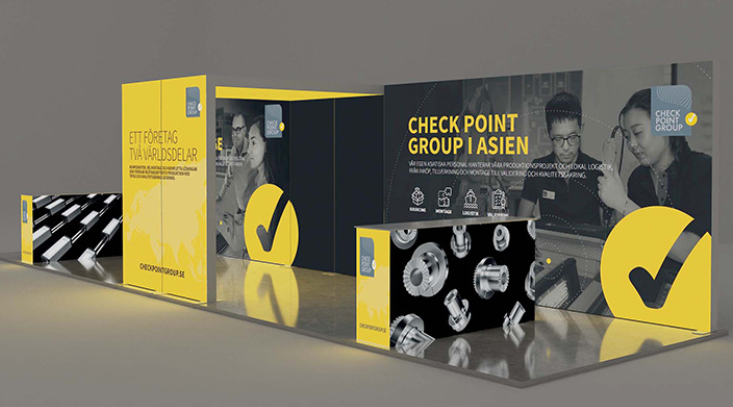
What is a modular booth?How is tool-free rapid assembly achieved?
If you are preparing for a brand promotion event or an industry exhibition, the last thing you want is this: the booth arrives at the venue, and you find that you need wrenches, drills, ladders, and you have to hire a professional construction team to spend most of the day. The modular booth is designed to solve this pain point—it breaks down the traditional booth into a set of standardized components that can be repeatedly assembled and disassembled, turning construction from an "engineering project" into "assembly."
The structural logic of the modular truss system
The core of a modular booth is a truss system. You can think of it as a set of high-strength "building blocks": the frame uses high-strength aluminum alloy profiles, and the connections use connectors made of reinforced engineering plastic and carbon steel. The entire system consists of three parts—truss rods, connection nodes, and accessories used to fix the graphics.
The key to this system lies in "standardization." The interface dimensions of all poles and connectors are unified, meaning you can freely combine different shapes and sizes based on the booth area, rather than being limited by fixed specifications. Whether you need a backdrop wall, an arched entrance, or a three-sided enclosed space, it can be achieved by adjusting the number of poles and the connection directions.
This is also the structural foundation that supports custom sizes and printed brand graphics.
Tool-Free Hand-Tightened Screw Connections: The Core Mechanism from Unboxing to Assembly
Tool-free assembly may sound like marketing jargon, but its implementation mechanism is actually quite straightforward: the connection nodes come with pre-installed hand-tightened screws (also called hand-rotating locks), which require no power drill or wrench—just rotate them by hand to lock or release.
The actual operation process is roughly as follows: after unboxing, insert the poles into the corresponding slots on the connection nodes, then rotate the hand-tightened screws on the nodes until the poles are firmly secured. Repeat this action until all frame connections are complete, and finally hang or snap on the printed brand graphics. The entire process requires no power tools and no professional installation qualifications.
Regarding sturdiness, here's what you need to know:
- The stability of this structure comes from "multi-point, multi-plane locking"—each connection point has an independent locking mechanism, and the overall load is distributed across various nodes rather than relying on a single load-bearing point.
- The aluminum alloy frame itself has a high strength-to-weight ratio, making it suitable for display purposes and light-to-medium load bearing (such as graphics, light boxes, and products on shelves).
- But "sturdiness" has its limits.It is suitable for indoor exhibitions, mall pop-up stores, and other static or low-vibration environments, but not for outdoor strong wind conditions, hanging heavy equipment, or scenarios requiring frequent pushing and pulling.
Who should use it, and who should reconsider:
| Suitable for | Need to be cautious |
| Standard booths, mall atrium promotions, brand pop-up events | Outdoor open-air activities (wind effects) |
| Teams that need multiple assembly and disassembly, or touring use | Displays that need to support heavy machinery or large amounts of inventory |
| Limited budget, not wanting to long-term rent storage and construction services | Complex shapes or special structural requirements for the booth |
If you plan to place heavy equipment or a large number of products on the booth, it is recommended to clarify the specific load-bearing requirements (what to place, how much, and where) before confirming the plan, and confirm with the current website team whether the structure matches your usage conditions.
Which promotional scenarios for a brand are best suited to modular exhibition booths?
The core value of modular exhibition booths lies in "quick assembly and disassembly, economical shipping, and flexible layouts," but not all promotional scenarios can turn these advantages into tangible benefits. To determine whether a scenario is suitable, first ask three questions: Is the setup time compressed? Is shipping charged by volume or weight?
Is the venue likely to require last-minute adjustments?
Overseas trade shows and industry exhibitions: tight time windows and high logistics costs
Overseas exhibitions are the most typical application scenario for modular exhibition booths. The reason is not that "modular sounds professional," but that it directly addresses two practical pain points:
- On-site setup time is usually only 4-8 hours。Traditional wooden booths require on-site cutting, painting, and drying, while modular booths are assembled with hand-tightened screws, requiring no power tools or professional personnel.If your team has only 2-3 people, this directly determines whether you can open on time.
- International shipping is charged by volume, not weight。The aluminum frame of a modular booth can be disassembled into standard-sized rods and connectors, and the packed volume is much smaller than that of a wooden structure of the same display area.The larger the booth area, the more obvious the shipping cost difference.
But one premise must be noted:The floor flatness, height limits, and fire protection ratings of overseas exhibition venues vary.Modular booths have certain requirements for floor flatness. If the venue floor has noticeable slopes or unevenness, you need to confirm with the current website team in advance whether additional leveling feet or counterweight solutions are needed.
Shopping mall pop-up stores and brand roadshows: variable venues requiring flexible layouts
Shopping mall atriums, outdoor plazas, and storefronts of brand stores—these venues share a common characteristic:The floor plan you receive may differ from the actual site, and setup time is often compressed to nighttime or a few hours after the mall closes.
The advantage of modular booths in such scenarios is their "reversibility": if assembled incorrectly, they can be disassembled and redone; if the position is unsuitable, they can be adjusted by moving, without the need for one-time fixing like welded structures. For pop-up stores, this means a single booth can be reused across multiple malls in different cities, with only the printed fabric graphics needing replacement each time.
However, there is an easily overlooked matching issue in pop-up store scenarios:Load-bearing and counterweight。 Atrium floors in shopping malls typically do not allow drilling or adhesive application, so booths need to remain stable through their own weight or counterweights. If your booth will display heavier product showcases or large-screen equipment, you need to confirm the load-bearing limit and counterweight plan with the current venue team, rather than assuming that 'modular equals versatile'.
Besides exhibitions, what other events can they be used for?
From a product structure perspective, the following scenarios are also applicable, but with lower priority than the first two categories:
- Internal company annual meetings or product launches: If held only once a year and the company has storage space, modular booths can be reused, making them more cost-effective than one-time construction.
- Dealer conferences or channel promotion activitiesWhen touring across multiple cities, the advantages of modular booths in transportation and reassembly are amplified.
- Outdoor brand exposure at sports events, music festivals, etc.: This is provided that the venue allows for ballast fixing, and weather conditions do not affect the aluminum frame and printed graphics.
Scenarios that are clearly unsuitable: Long-term fixed exhibition halls (not dismantled for more than 3 months) — in this case, traditional wooden or metal welded booths have lower unit costs, and the modular disassembly advantages are not utilized;Brand launches with extremely high custom shaping requirements for display surfaces — modular booths are primarily based on straight lines and standard angles, and complex curved surfaces require additional customization, eliminating cost advantages.
The next step is to confirm: does your event venue allow drilling or adhesive application? What is the weight of the heaviest single item among the exhibits, in kilograms? How many people are on the setup team, and do they have an electrician's certificate?
Share these three answers with your current website team to determine whether a modular booth matches your specific event.
How should you read the key parameters of a modular booth?Which ones directly affect your selection?
When choosing a modular booth, the biggest fear is being overwhelmed by a flood of parameters, only to find that it either can't be assembled or falls apart after two uses. In reality, only three dimensions truly influence your decision: material structure, customization space, and reusability.
Material and Structure: How Aluminum Frames and Connectors Affect Durability
The frame material directly determines what the booth can withstand. This current product adopts a high-strength aluminum alloy frame, combined with reinforced engineering plastic and carbon steel connectors. The rationale behind this combination is:
- Aluminum alloy frame: Lightweight, so one person can carry it;also corrosion-resistant, and not easily deformed after transportation bumps.Compared to iron frames, it won't rust after sitting in a warehouse for months.
- Carbon steel connectors: Key load-bearing points. Connectors are the areas with the highest stress concentration. Carbon steel is more resistant to wear from repeated assembly and disassembly than pure aluminum, and won't strip threads on the fifth setup.
- Engineering plastic components: Used in parts subject to frequent operations such as hand-tightened screws, reducing direct metal-to-metal friction and extending service life.
Key trade-offs: An all-metal structure is more durable but heavier and more expensive;an all-plastic structure is cheaper but has poor load-bearing capacity. The "aluminum + carbon steel + engineering plastic" combination of this model is a balanced solution—suitable for small to medium-sized booths (typically 9-18 square meters), but not for suspending heavy ceilings or large screens.
Criteria for assessing stability: After assembly, vigorously shake the top beam and observe whether there is obvious displacement at the connection points. A qualified modular booth should have minimal sway after being properly locked.
Customization capabilities: room for adjusting dimensions, layout, and branding graphics
This booth supports full customization of dimensions, layout, and branding graphic printing, but "being customizable" and "how to customize" are two different things.
Dimension customization: The truss structure can theoretically be combined arbitrarily according to the booth area, but note that dimension changes will affect the accessory list. For example, changing from 3x3 meters to 3x6 meters does not simply double the number of horizontal beams and connectors; the ratio of corner pieces and support pieces will change. When selecting, directly tell the team your booth area and let them provide the structural list, rather than estimating it yourself.
Branding graphics: Graphic printing is the area where modular booths are most likely to deliver striking results, yet also the most prone to issues. What you need to confirm is: Is the graphic directly attached to the truss, or do you need to purchase additional backing panels or fabric-stretching accessories? Different installation methods affect the flatness of the graphic and whether marks are left after dismantling.
Layout Adjustment: The value of modular booths lies in the ability to configure the same frame into different forms, such as inline, L-shaped, or island layouts. If you have plans for multi-city touring exhibitions, prioritize confirming whether this system requires additional conversion accessories when switching between different layouts.
Number of Reuses: Actual Lifespan Depends on How You Assemble and Dismantle
No manufacturer can give you a more reliable figure for "how many times it can be used with confidence," because the lifespan depends on the way it is used. But you can judge by asking two questions:
- Are the connectors replaceable??If a connector wears out, can you buy a replacement separately, or must the entire unit be scrapped?A replaceable design means the lifespan of the booth is "unlimited."
- Is it transported as a whole or disassembled??Disassembled and packed in flight cases offers the best protection.If you frequently haul it as a whole without disassembling, the connectors will accelerate fatigue due to continuous stress.
This booth features a tool-free hand-tightened screw design for quick assembly and disassembly, but it also means you cannot use power tools to over-tighten—hand-tighten to the proper torque; excessive force can damage the threads.
Next, confirm the actionProvide the current website team with your booth area, planned annual usage frequency, and transportation method (own vehicle or logistics), and let them provide the corresponding accessory list and consumable replacement recommendations. If you have needs for hanging screens or heavy displays, be sure to specify this in advance, as it is necessary to confirm whether the load-bearing limit matches.
How to determine if a modular booth is suitable for your promotional activities?
Modular booths are not a one-size-fits-all solution; their value depends on your event type, usage frequency, and setup conditions. Below are the criteria for making this judgment.
Three situations suitable for choosing a modular booth
1. You have multiple promotional or exhibition plans within a year
This is the most critical determining factor. The advantage of modular booths lies in their repeatable assembly and disassembly. If you have more than 3 exhibitions, mall pop-ups, or brand promotion events this year, the single-time construction cost will be amortized as the number of uses increases. Traditional custom booths are basically a one-time investment, discarded after dismantling, with almost zero reuse rate.
2. Strict Time Limits on Setup and Teardown
Many mall atriums and hotel event venues only give you a 4-6 hour window for setup. Modular booths use tool-free hand-tightened screws for connection, requiring no welding, cutting, or painting. Skilled workers can complete the main frame assembly in a short time. Traditional custom booths usually require early entry and coordination of multiple trades, with many uncontrollable time factors.
3. The Team Needs to Control the Setup Process Itself
If you do not have a long-term booth builder, or wish to reduce reliance on third-party construction teams, the high-strength aluminum alloy frame and standard connectors of modular booths allow internal teams to complete assembly with simple training. This saves project management and communication costs.
Boundary conditions for not recommending modular booths
Single large-scale exhibition with pursuit of ultimate brand visual impact
If you only attend one large industry exhibition, have a sufficient budget, and need complex visual effects such as irregular shapes, double-deck structures, and large illuminated light boxes, traditional custom booths still have advantages. Although modular booths support customized graphics and dimensions, their structure is essentially a linear truss system, which is limited in complex shapes such as curved surfaces and cantilevers.
The venue has special load-bearing or hanging point requirements
Modular booths are self-supporting structures and do not need to rely on venue hanging points. However, if your event requires hanging heavy LED screens (each exceeding 200 kg) or large mechanical installations, you need to confirm with the current venue team the load margin of the truss and the load-bearing limit of your selected specifications. Do not estimate based on experience with traditional booths.
How to Allocate the Budget
The budget logic for modular booths differs from traditional booths. The key differences are:
| Cost Item | Modular Booth | Traditional Custom Booth |
| Initial Purchase | One-time investment in frame + connectors + graphics | Design + construction + materials, one-time investment |
| Subsequent use | Only the graphics need to be replaced; the frame can be reused | Redesign and rebuild every time |
| Storage and transportation | Compact after disassembly, can be transported by yourself | Waste requires disposal, no reuse value |
| Hidden costs | Storage space needs to be reserved. | Construction suppliers need to be managed continuously. |
Specific recommendations: In the initial budget, the frame system accounts for about 60-70%, while graphics and accessories account for 30-40%. If the budget for a single event is less than 20,000 yuan and there is no plan for reuse in the future, it is recommended to directly rent a traditional booth;If the budget for a single event is over 30,000 yuan and it is planned to be used more than twice, the comprehensive cost advantage of modular booths will truly be reflected.
Frequently Asked Questions
Q: Which is more cost-effective, a modular booth or a traditional custom-built booth?
It depends on the number of uses. For a single use, traditional custom booths are more cost-effective;For two or more uses, the total cost of modular booths (including storage, transportation, and installation labor) is usually lower. It is recommended to do a simple calculation based on your annual number of events.
Q: How much promotional material can a modular booth support?
This depends on the truss specifications and span you choose. Standard configurations are suitable for light boxes, acrylic letters, banners, and regular display cases;If you need to hang heavy equipment, you must provide the specific weight and hanging position to the current website team, and they will confirm the structural solution.
Q: Is it troublesome to change the graphics?
Not at all. Graphics on modular exhibition stands are typically fixed using fabric tensioning or panel mounting, so changing the graphics does not require disassembling the main frame. It is recommended to prepare multiple sets of graphics in advance and swap them out according to different event themes.
Q: Can our internal team handle the assembly without professional builders?
Yes. The products feature a tool-free hand-tightened screw design, so no power drill or wrench is needed. It is recommended to request the assembly diagram from the current website team before the first setup and arrange a trial assembly. Once familiar, 2-3 people can complete the assembly of a standard booth within a few hours.
Learn More
If you are planning your next trade show or promotional event, feel free to provide our team with your booth area, event frequency, and setup conditions. We will match you with the most suitable modular booth solution and provide a detailed accessory list and cost estimate.
Related Products:Custom Modular Truss Trade Show Booth | Tool-Free Quick Assembly Portable Exhibition System