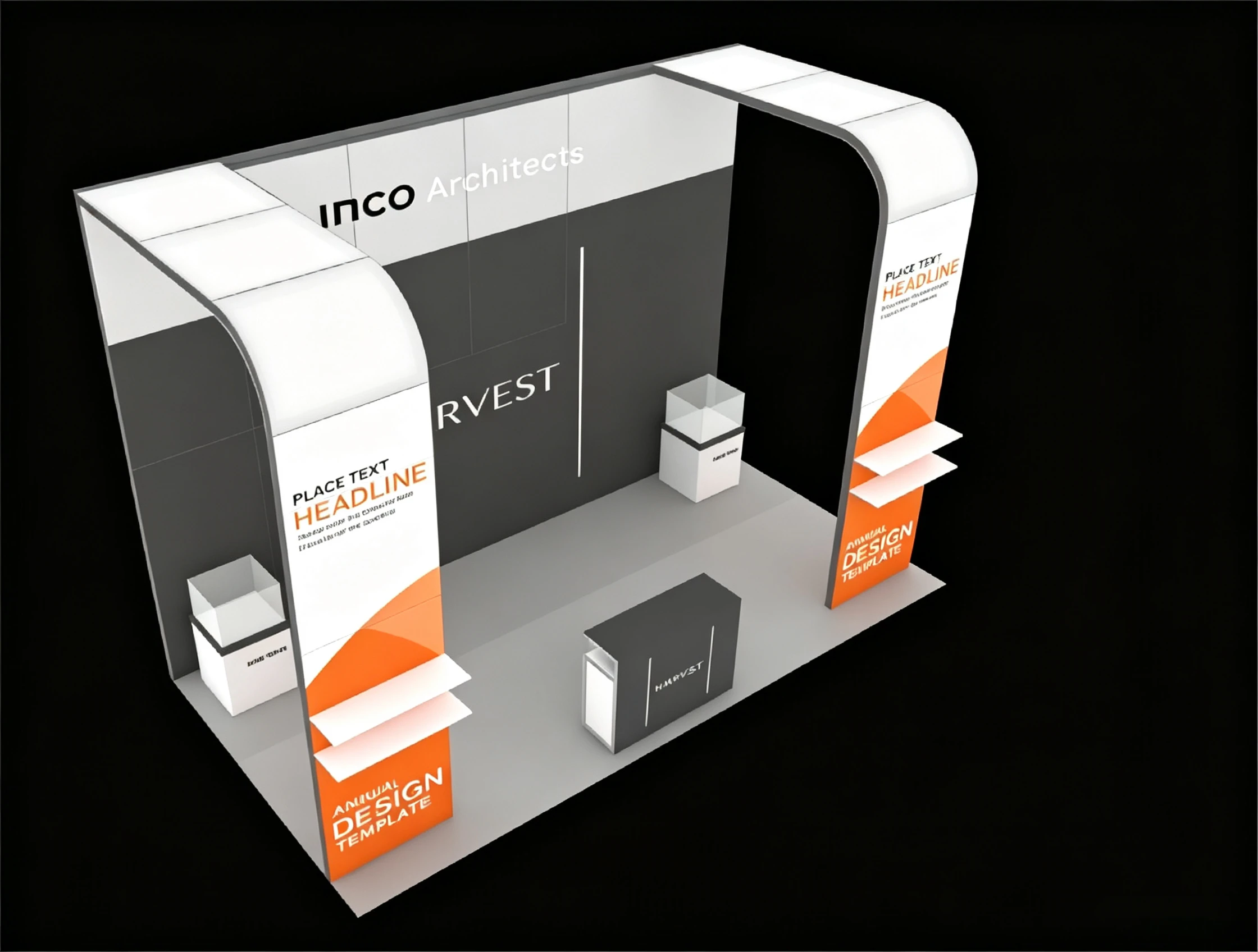
Why can't the cost of an exhibition booth be evaluated only by the purchase price?
The purchase price of a booth is just the tip of the iceberg. What really affects the budget is the complete chain from design, construction, transportation, storage to final dismantling and recycling - we call it the "total cost of ownership". Many planning companies only focus on the numbers on the supplier's quotation when comparing prices, and as a result, they keep adding to the budget in subsequent stages: overtime pay for construction overruns, extra charges for oversized transportation, and garbage disposal fees for dismantling one-time wooden structures.
These hidden expenses add up, often exceeding the purchase price by more than 40%.
From "purchase price" to "total cost of ownership": calculate six accounts clearly
To evaluate the true cost of a booth system, you need to look at at least the following six aspects:
- Procurement cost: Initial purchase cost of frames, panels, and accessories.
- Labor for setup and dismantling: On-site assembly and disassembly hours for each exhibition.Traditional carpentry typically takes 2-3 days to build a 30㎡ booth, while modular frame systems can compress this to a few hours.
- Transportation and storage: The volume and weight of booth components determine logistics costs and warehouse occupancy costs.Disposable wooden booths are discarded after use, so there is no storage issue, but they must be repurchased each time;Reusable systems, on the other hand, require consideration of round-trip transportation and off-season storage.
- Wear and tear and maintenance: Wear, loss, and damage of components during repeated assembly and disassembly.The durability of the aluminum frame directly affects this aspect.
- Venue and safety compliance: Some exhibition halls have specific requirements for booth height, fire resistance rating, and structural stability.If the system cannot meet these, additional reinforcement or special approval may be required, incurring extra costs.
- Dismantling and recycling: Costs for disposing of waste materials after the exhibition ends.Wooden booths are usually disposed of as waste, while metal frames can be recycled or kept for next use.
How the Fast62 Aluminum Frame System Changes the Cost Structure
The core logic of Fast62 is to turn 'one-time consumption' into 'reusable assets'. It uses 62mm high-strength aluminum alloy profiles, welded one-piece corner brackets, with a maximum construction height of 4.5m, and is paired with flame-retardant stretch fabric panels to form a complete modular booth system. This means:
- Construction labor is compressed from 'days' to 'hours': The modular quick-assembly design reduces on-site working time, directly lowering labor costs—which, in the European and American exhibition market, is often the largest single expense in a booth budget.
- Transport volume is significantly reduced: The frame can be disassembled into standardized components, requiring less transport vehicles and storage space compared to a wooden booth of the same area.
- Reuse reduces per-use cost: A single Fast62 system can support dozens of exhibitions in a cycle.Assuming the purchase cost is 3 times that of a one-time wooden structure, as long as it is used more than 3 times, the amortized cost per use begins to be lower than the one-time solution.
- Compliance risks addressed upfront: It is CE certified and complies with ISO9001, ISO14001, and ISO45001 management system requirements. With the optional flame-retardant fabric, it meets safety inspection standards of mainstream exhibition halls in Europe and the US, reducing on-site rectification risks.
Key trade-off: If your client only attends one exhibition and has no plans for continuous participation in the future, purchasing Fast62 is not cost-effective—rental or one-time wooden structures are more suitable. But if your business model is to serve brand customers who participate in exhibitions year-round, or if you are a booth construction service provider hoping to build a reusable exhibit asset library, the cost structure advantage of Fast62 will begin to show from the 2nd to 3rd use.
Next step confirmation action: Provide your typical booth area, annual exhibition frequency, height restrictions of commonly used halls, and transportation routes to the current website team, and let them estimate the total cost of ownership comparison based on your specific usage scenarios, rather than just looking at the purchase quotation.
Procurement and Construction: How are the initial investment and labor costs of Fast62 calculated?
When purchasing a booth frame, what you actually buy is not just aluminum profiles, but the 'construction efficiency for every exhibition in the coming years'. The cost logic of Fast62 should be viewed in two stages: the one-time material investment at the time of purchase, and the labor investment for each exhibition construction.
62mm Aluminum Profile and Welded Corner Brackets: A Structure Designed for Reuse
The core structure of Fast62 is a 62mm high-strength aluminum alloy profile (cross-section 65.5mm × 45.4mm), connected with welded one-piece corner brackets. There are two key points here that directly affect your purchasing decisions:
First, the "thickness" of the profile determines how high it can support. The 62mm cross-section thickness allows the system to be built up to 4.5m, which means if you frequently do double-deck structures or tall entrance facades, Fast62 has more load-bearing margin than thin-wall profiles. Conversely, if your booth is always a standard single-story under 3m, the cost premium of this thickness may not be worth it—this is the first question to confirm with your team before purchasing: **What is the maximum height your booth needs to reach in the next two years?
**
Second, welded corner brackets mean "cannot be disassembled," but also mean "no need for repairs." Welded one-piece corner brackets have no system slots, are finalized at the factory, and do not require on-site alignment, leveling, or screw tightening to correct angles. The trade-off is: during transportation, the corner brackets cannot be laid flat and stored like split corner codes, so the logistics volume per shipment is slightly larger.
But the benefit is: each setup eliminates a step where "wrong assembly requires redoing," and the welded structure will not cause frame wobble due to loose screws after repeated assembly and disassembly 20-30 times—this is especially important for rental companies, as equipment wear costs are often more hidden than procurement costs.
How does the modular quick-assembly design reduce labor costs for setup and dismantling?
The cost-saving logic of modular design is not about 'installing fewer pipes,' but aboutreducing on-site decision-making and rework.。
Traditional truss or custom wooden structure booths require on-site measurement, cutting, and adjustment. Setting up a standard 9㎡ booth typically takes 2-3 people 4-6 hours. Fast62's modular quick-assembly logic is: the frame components are already size-matched at the factory, and on-site workers only perform three actions: 'align-insert-tension,' without needing any power tools or cutting equipment. According to industry norms, skilled workers can set up a booth of the same size in 2-3 hours, and dismantling time is about 60% of the setup time.
But there is a prerequisite that you and your team need to confirm:Are your workers familiar with this type of tensioned fabric frame system? The first setup involves a learning curve; usually, the pace picks up starting from the second booth. If your setup team is long-term outsourced and changes each time, the time-saving advantage of modularization will be diluted—in this case, you need to confirm with your current booth team whether they provide on-site guidance or a setup manual, to assess the actual time required for the first setup.
Teams suitable for the Fast62 procurement logic:
- Participate in exhibitions more than 3 times a year, with reusable frames that amortize the material cost per event
- Booth height often exceeds 4m, requiring stable load-bearing structures
- Setup workers are relatively fixed, able to accumulate quick-assembly experience
Teams not suitable:
- One-off exhibitions or participating once a year, with too long a depreciation cycle for materials
- When the booth area is less than 6 square meters, the strength advantage of the 62mm profile cannot be fully utilized, and there are lighter alternatives.
The next step is not to compare prices, but to list all your booth size and height requirements for the next 12 months, along with the skill level of your assembly workers, and submit them to the current website team so they can provide matching profile configurations and an estimated time for the first assembly.
Transportation, Storage, and Maintenance: Which Hidden Costs Are Overlooked?
In the booth budget, the three costs of transportation, storage, and maintenance are easily underestimated. Transportation is charged by volume, storage by floor area, and maintenance involves labor and replacement costs. Fast62's demountable modular structure and high-strength aluminum profiles offer cost advantages in these three areas.
How the Demountable Structure Reduces Transportation and Storage Costs
Fast62 adopts a modular demountable design: the frame can be disassembled into 62mm aluminum profile rods, and the fabric can be folded and packed, rather than being a fully welded structure. After the rods are tightly bundled, the transport volume is more compact than that of an integrated truss of the same height. Logistics companies usually charge by volume, so a reduction in volume directly lowers the cost per shipment.
For teams exhibiting across cities or countries, this difference accumulates with each exhibition.
In terms of storage, the disassembled rods and fabric can be laid flat or stacked, occupying less warehouse space than a fixed frame. For users who pay storage fees by area, this means lower storage costs.
How the durability of aluminum profiles reduces maintenance and replacement costs
The Fast62 main body is made of 62mm high-strength aluminum alloy profiles, paired with welded corner brackets. Aluminum has rust-proof properties, eliminating the need for regular rust treatment or repainting like iron trusses. The matching fire retardant fabric (optional) can be removed and replaced separately. In case of partial damage, there is no need to scrap the whole unit; only the corresponding fabric needs to be replaced.
It should be noted that the surface of aluminum profiles may get scratched due to collisions during transportation. For scenarios with high requirements on booth appearance, it is recommended to add soft interlayer protection. If welded corner brackets are damaged, they need to be returned to the factory for repair. Although this is not common, rental companies should assess their own repair response capability. Overall, the maintenance frequency and replacement cost of Fast62 are lower than those of one-time wooden booths that require frequent repairs.
How to calculate the total cost over five years?Who is Fast62 suitable for, and who is it not suitable for?
Whether to buy Fast62 or not, the key is not the unit price, but how many times it can be amortized in your hands. The cost advantage of the aluminum frame system comes from repeated use, so first calculate your own exhibition frequency, and then discuss whether it is worth it.
A reusable calculation framework: deriving the per-use cost from participation frequency
Assume the procurement cost of a Fast62 standard booth frame is P, the accompanying graphics and accessories are A, and the transportation, setup labor, and storage maintenance per exhibition are V. Then:
Per-use cost = (P + A) ÷ number of uses + V
The key variable is the "number of uses". If you participate in 2 exhibitions per year and the system is used for 5 years, that's 10 uses;if you participate in 6 exhibitions per year, that's 30 uses over 5 years. With the same frame system, the per-use amortized cost differs by a factor of 3.
Another easily overlooked point is the setup time. The welded integrated corner brackets and modular design of the Fast62 mean that skilled workers can save several hours per setup compared to traditional wooden structures. When you factor this labor cost into V, the savings for frequent users become even more apparent.
Decision boundary: Prioritize for frequent exhibitors; for low-frequency or temporary needs, consider renting.
Who should buy the Fast62:
- Those who exhibit 4 or more times a year: This is a relatively clear dividing line.Based on a 5-year lifecycle, with at least 20 uses, the procurement cost of the frame itself can be fully amortized.
- Has fixed storage space: Aluminum frames need storage. If there is no stable warehouse between exhibitions, handling and damage risks will eat into the cost advantage.
- Has height requirements for the booth: Fast62 supports a maximum construction height of 4.5m. If your exhibits or brand image require a high-ceiling space, the rental market often cannot match it in time, and owning the system gives you more control.
People who are not recommended to buy Fast62:
- Exhibit 1-2 times a year with no future plans: With low-frequency use, the per-use cost may be higher than renting, and you also have to bear storage and transportation management costs.
- Booth area and layout vary greatly each time: Fast62 is a modular system, but if your booth jumps from 9 square meters to 100 square meters each time with vastly different designs, the accompanying graphics and accessories need to be frequently redone, and this cost will offset the advantage of frame reuse.
- No in-house assembly team: If you outsource assembly every time, labor costs cannot be optimized through reduced proficiency, and the system's time-saving advantage will be weakened.
How should the budget be allocated?
If you decide to purchase, it is recommended to plan according to the following proportions:
- Frame main body (about 50-60%): This is the core asset, determining structural stability and service life; do not cut corners here.
- Graphics and accessories (about 25-30%): The visuals need to be updated for each exhibition, which is a consumable investment, but Fast62's modular design makes changing visuals faster than traditional booths, so this part of the budget can be flexibly adjusted per event.
- Logistics and warehousing (approximately 10-15%): The aluminum frame is not light in weight, so cross-city transportation costs need to be included in advance; don't just calculate the purchase price.
A practical suggestion: if you are unsure which category you belong to, you can start with a set of standard sizes, use 1-2 exhibitions to verify the frequency of use and assembly efficiency, and then decide whether to expand. If after verification you find it not cost-effective, the loss from second-hand disposal is far less than investing in multiple systems at once.
Frequently Asked Questions
Q: I only participate in exhibitions twice a year. Should I completely not consider Fast62? A: Not necessarily. If the single booth area is relatively large (e.g., over 36 square meters), the cost of renting a frame of the same specification will increase significantly. In this case, even if the self-owned system is used infrequently, it may pay for itself within 2-3 years.
It is recommended to substitute the actual rental quotes into the above formula for comparison.
Q: Is the cost of changing graphics for Fast62 high? A: The graphics themselves are consumables, but the modular structure of Fast62 makes graphic installation and removal faster than traditional wooden structures, resulting in lower labor costs. The specific cost of graphics depends on the area and material. There is a price difference between fire-retardant fabric and regular fabric, so you need to confirm the current quote with the team.
Q: Will limited storage conditions affect this decision? A: Yes. Although the aluminum frame is corrosion-resistant, it requires a dry and flat storage environment.
If there is no fixed warehouse between exhibitions, it is recommended to prioritize renting one, or confirm whether the supplier provides warehousing support solutions.
Q: Can Fast62 adapt to booths of different sizes? A: It can be modularly expanded, but each time the area is significantly adjusted, the matching graphics and some connectors may need to be reconfigured. It is recommended to first confirm the range of booth areas you commonly use, and then check with the team which accessories need to be purchased additionally.
Learn More
For further selection advice, please submit your operating parameters, and our technical team will provide professional judgment.