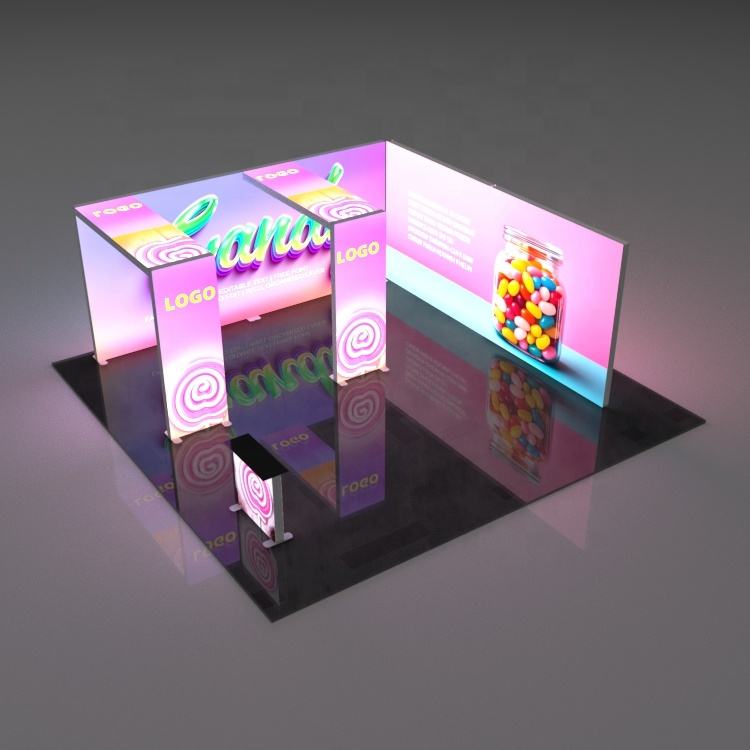
Why does the safety compliance of temporary structures for meetings and events start with the frame structure and fabric?
For temporary structures at exhibitions and events, safety reviews typically do not look at the appearance design first, but instead start from two physical aspects:whether the structure can withstand the actual load, andthe performance of materials in fire scenarios. These two points determine whether the construction plan can pass the venue approval, and are also directly related to the safety of on-site personnel.
Where do the safety risks of temporary structures concentrate?
From common issues in past booth constructions, the risks mainly concentrate in the following aspects:
- Connection node failure: The load-bearing points of the frame are concentrated at the connections between columns and beams.If screw splicing or pin connections are used, looseness is prone to occur after repeated assembly and disassembly over time, especially under dynamic loads such as air conditioning airflow in the exhibition hall or people leaning against the structure, which can compromise overall stability.
- Insufficient overall anti-tilt capability: When the construction height exceeds 3 meters, lateral forces (such as pulling hanging objects or people colliding) become the main risk.Slender frames are prone to deformation under lateral forces, which in severe cases may lead to overall tilting.
- Fabric flame retardant rating does not meet standards: Many venues have clear flame retardant requirements for fabric materials used in booths.Ordinary decorative fabrics tend to melt or accelerate burning at high temperatures, while flame-retardant fabrics, through special treatment or the inherent properties of the fibers themselves, can self-extinguish after the ignition source is removed.
How does the Fast62 aluminum frame structurally address stability issues?
The core structural response of Fast62 lies inwelded corner bracketsas the chosen process. Traditional quick-assembly frames typically secure corners with corner brackets or bolts, whereas Fast62's corner brackets are welded to the profiles to form a single unit, eliminating system slots and splice gaps. This means that under load, forces are transmitted to the ground through a continuous metal path, rather than being concentrated at a single bolt point.
For rental scenarios requiring repeated assembly and disassembly, welded corner brackets also avoid the 'loosening over time' problem caused by wear on connectors after multiple cycles.
Combined with the 62mm aluminum profile cross-section (65.5mm × 45.4mm), Fast62 achieves a maximum construction height of 4.5 meters. This height covers the needs of the vast majority of exhibition booths and conference backdrop walls, and the rigidity of the profile cross-section ensures that the frame will not show visible shaking when built to full height.
It should be noted thatstructural stability does not automatically mean compliance。 During review, the venue will also conduct a comprehensive assessment based on specific conditions such as booth area, top hanging weight, and floor flatness. If your plan involves top hanging points or special shapes exceeding 4.5 meters, you need to provide detailed construction drawings and load distribution to the current website team, who will assist in confirming a matching solution.
Regarding fabric, the stretch fabric provided with Fast62 offers a flame-retardant version option to meet safety inspection requirements of mainstream exhibition halls in Europe and North America. When selecting, it is recommended to confirm directly with the team whether the venue you plan to exhibit at has specific standards for flame retardancy (such as B1 level or NFPA 701), so as to match the corresponding fabric specifications.
How high can Fast62 be built?What determines stability at a height of 4.5 meters?
What does a 4.5-meter build height mean for conference events?
4.5 meters is not an arbitrary number. In the exhibition industry, this height covers the height limits of most standard and custom booths—most domestic exhibition halls have height limits between 4 and 6 meters, while safety inspections at major European venues typically review temporary structures within 4.5 meters as routine. In other words, Fast62's 4.5-meter limit falls exactly within the range where most events do not require additional approval for special structures.
But 'can be built to 4.5 meters' and 'remains stable at 4.5 meters' are two different things. Many modular frame systems claim high heights, but when actually built to the top, problems such as frame wobble, loose skin, and loose connectors can occur. The key to Fast62 daring to set 4.5 meters as the nominal upper limit lies not in the aluminum tube itself, but in the coordination logic between the corner fittings and the cross-section.
How do welded corner fittings and profile cross-sections work together to more reliably ensure structural stability?
Let's start with the cross-section. Fast62 uses 62mm aluminum alloy profiles, with a cross-section size of 65.5mm × 45.4mm. This size means the moment of inertia of the profile is large enough—simply put, the profile has a stronger ability to resist bending deformation.
At a height of 4.5 meters, the frame columns mainly bear the bending moments caused by lateral wind loads and skin tension. The larger the cross-section, the smaller the deflection deformation of the columns under load.
Now, about the corner fittings. This is the core difference between Fast62 and many similar products: its corner fittings are welded as an integrated structure, rather than assembled on site with bolts or corner brackets. Welded corner brackets mean that every node of the frame is a rigid connection, allowing forces to be transmitted directly through the nodes, rather than relying on the friction of bolts or the gripping force of corner gussets.
In tall assembly scenarios, the nodes are often the weakest link of the entire frame—bolted connections tend to loosen after repeated assembly and disassembly, and corner gussets may experience micro-displacement under load, all of which can be amplified into visible sway at a height of 4.5 meters. Welded corner brackets eliminate this problem, making the node stiffness close to that of the profile itself.
The logic of their combination is: the profile cross-section is responsible for 'bearing the force,' while the welded corner brackets are responsible for 'transmitting the force through.' If you have a large cross-section but the nodes are assembled, the force will 'break' at the nodes;If you only have welded corner brackets but the profile is too thin, the profile itself will bend first. Fast62 achieves both simultaneously, which is why 4.5 meters is set as the safe upper limit.
Next confirmation action: If you plan to build to a height close to 4.5 meters, it is recommended to confirm two points with the current website team: first, the fabric material and tensioning method you plan to use (different fabrics exert different lateral forces on the frame);second, the ceiling height of the construction site and the position of the air conditioning vents—if the top of the frame is directly facing a vent, the local wind load will increase significantly, and it may be necessary to add diagonal bracing or counterweights. Only after confirming these two points can you determine whether 4.5 meters requires additional reinforcement in your specific scenario.
How does flame-retardant fabric meet safety standards for venues in Europe and the United States?The material selection logic of Fast62
The flame-retardant requirements for temporary structures in mainstream European and American exhibition halls are not a 'suggestion' but an 'entry condition.' Exhibition halls in Munich, Las Vegas, London, and other places, during the construction approval process, require the submission of flame-retardant grade certificates for construction materials, especially for large-area vertically hanging textile materials such as tarpaulins and stretch fabrics. If the fabric is judged to be substandard, at best it will need to be replaced on site; at worst, the entire construction will be halted—this risk should be eliminated during the event planning stage, rather than being remedied only upon entering the venue.
What are the flame retardancy requirements for temporary construction materials in European and American venues?
The flame retardant standards systems implemented by different countries and venues are not entirely unified. Common in the European market areDIN 4102 B1(German standard, requiring materials to be difficult to ignite) orEN 13501-1class B-s1,d0;In the American market, fabrics are typically required to passNFPA 701test, this standard specifically targets the flame spread performance of textiles and films. Some venues also require the original test report to be provided, rather than relying solely on the supplier's verbal commitment.
The key point is:Flame retardancy is not a single attribute of the fabric, but the result of the combined effect of the "base fabric + coating/treatment process"。 For stretch fabrics with the same appearance, whether they have undergone flame-retardant treatment and whether the treatment process is stable directly determines whether they can pass venue inspections. This is also why in conference and event setup, one cannot only look at the fabric's color and texture; it is necessary to confirm the flame-retardant grade certificate and the corresponding test standard.
How do Fast62's flame-retardant fabric options adapt to different venue inspections?
The Fast62 system itself is a 62mm aluminum alloy frame structure, and the metal skeleton poses no combustion risk. The venue review focuses on the accompanying stretch fabric. Fast62 offersoptional flame-retardant fabric, which meets the entry inspection requirements of mainstream venues in Europe and North America. This means that when choosing Fast62, you need to specify the fabric specification based on the event location:
- European venue events: Confirm whether the fabric has the corresponding DIN 4102 B1 or EN 13501-1 rating, and obtain the test report for setup approval.
- North American venue events: Confirm whether the fabric passes NFPA 701, and retain the test documents for future reference.
- Touring events (multiple countries and locations): It is recommended to directly choose a flame-retardant fabric solution that covers both European and American standards, to avoid having to re-confirm every time you change cities.
It should be noted that the flame-retardant fabric for Fast62 is anoptional configuration, not a default standard feature. If your event venue does not have mandatory flame-retardant requirements, standard fabric can reduce costs;but as long as European or American venues are involved, we recommend opting for flame-retardant fabric—not just for 'in case of inspection,' but because venue audits are a deterministic process, not a probability event.
Decision-making advice: When inquiring with the Fast62 team, directly inform them of your event city and venue name, confirm which flame-retardant standard system is implemented at that venue, and ask the team to provide the test report number for the corresponding fabric. If an event spans multiple locations in Europe and the United States, prioritize flame-retardant fabric solutions that meet both NFPA 701 and DIN 4102 B1 to avoid repeated communication and replacement costs.
What conference and event scenarios is Fast62 suitable for?In which situations is it not recommended?
To determine whether Fast62 is suitable for your project, focus on three key aspects: whether the construction height is within 4.5 meters, whether the venue requires flame-retardant fabric, and whether the booth is planned for repeated use. Based on these three points, the boundaries of suitable scenarios are actually very clear.
Conferences and forums, brand pop-ups, and industry exhibitions: typical suitable scenarios for Fast62
Industry exhibitions and business matchmaking eventsare the most direct application scenarios for Fast62. Booth heights typically range from 3m to 4m. Fast62's 62mm aluminum frame, combined with welded corner brackets, supports a maximum build height of 4.5m, covering the height restrictions of most exhibition halls. The welded corner brackets mean the frame has no system slots, providing better overall rigidity, and it is less prone to shaking under slight vibrations caused by ventilation equipment or dense crowds in the exhibition hall.
For exhibitors who need to tour across cities or even countries, Fast62 can be disassembled and reassembled, and the fabric can be replaced. A single frame can be used multiple times, spreading the cost of each setup.
Brand pop-up stores and commercial atrium eventsare also suitable. These scenarios often have only a 1 to 3 day setup window. Fast62's modular quick-install design can significantly reduce on-site construction time. If the event venue is in a shopping mall or public space, fire safety review usually requires that the display fabric have flame-retardant properties. Fast62 offers flame-retardant fabric options, but this needs to be confirmed in advance with the current website team regarding the fabric grade and its match with the venue requirements.
Corporate annual meetings, product launches, peripheral registration areas, or brand display zonescan also be considered. These areas do not require complex water supply and drainage or heavy equipment load-bearing. Fast62's aluminum alloy frame combined with stretch fabric can quickly form a clean brand visual surface, and after disassembly, the storage volume is small, making it suitable for event companies to stock and reuse.
When is Fast62 not the optimal choice?
Construction heights exceeding 4.5mare the first hard boundary. If the event requires a two-story structure, a raised entrance height exceeding 4.5m, or the top needs to suspend heavy LED screens, Fast62's frame system is not applicable. In such cases, truss or custom steel structure solutions should be used instead.
Scenarios with heavy exhibits or large quantities of physical displays require caution.Fast62 is a fabric frame system suitable for displaying graphics, light boxes, and light to medium products, but it is not suitable for bearing physical items that exceed the frame's design load. If you plan to hang shelves or equipment weighing more than 20kg on the frame, you need to confirm the hanging points and load-bearing limits with the current website team first, and do not estimate on your own. For booths with strict requirements for wood texture or fully enclosed privacy, Fast62 may not meet expectations.
Its visual presentation is mainly stretched fabric. Although various shapes can be achieved with accessories, it cannot replace the high-end texture of painted wood.If the brand tone requires solid walls, solid wood, or metal finishes, Fast62 is not a suitable choice. Its visual presentation is dominated by stretch fabric. Although multiple styling options can be achieved through accessories, it cannot replace the high-end texture of painted woodwork. If the brand tone requires solid walls, solid wood, or metal finishes, the Fast62 is not a suitable choice.
For a small standard booth that is single-use and has an extremely low budget, it may not be cost-effective either. The value of Fast62 lies in repeated use and quick setup. If it is only a one-time 9-square-meter standard booth with no follow-up exhibition plans, renting standard booth equipment may be more economical than purchasing Fast62.
Key trade-off summary: Fast62 is suitable for projects that involve "multiple uses, medium height, quick setup, and fabric visuals";it is not suitable for projects that involve "ultra-high structures, heavy hanging loads, woodwork texture, or single use." If you are unsure which side your scenario falls on, the next step is to provide the current website team with three pieces of information—setup height, expected number of uses, and the venue's flame retardant requirements for fabrics—so they can determine whether Fast62 is a match or offer an alternative solution.
Frequently Asked Questions
Q: Can Fast62 build a two-story booth? No. The maximum construction height for Fast62 is 4.5m, which is the upper limit for a single-story frame and does not support a two-story structure.
If you need a two-story booth, you should directly consider truss or steel structure solutions.
Q: The venue requires flame-retardant materials. Can Fast62 meet this requirement? Fast62 offers flame-retardant fabric options, but different venues may have different specific standards for flame retardancy levels. You need to provide the venue's fire safety acceptance requirements (such as specific flame retardancy level standards) to the current website team, and they will confirm whether the fabric matches.
Q: How many times can a set of Fast62 be used approximately? The frame is made of aluminum alloy and can be reused dozens of times under normal transportation and assembly conditions. The actual lifespan depends on frequency of use, transportation protection, and on-site operating procedures.
The fabric is a consumable item and may need replacement after multiple assemblies and disassemblies; the replacement cost is lower than remaking the entire booth.
Q: How heavy exhibits or screens can Fast62 support? The frame itself has structural strength, but the specific hanging point positions and load limits depend on the selection of accessories and installation methods. If you have specific hanging requirements, you need to provide the weight of the exhibits and the hanging positions to the current website team, and they will provide a hanging point plan and load confirmation.
Q: If my booth height is exactly 4.5m, can Fast62 be used? 4.5m is the maximum assembly height; theoretically it is possible, but the closer to the height limit, the higher the requirements for floor flatness and installation precision. It is recommended to inform the current website team of the actual construction height and site ground conditions before confirming the plan, and to confirm whether reinforced fixing measures are needed.
Learn More
If you are planning an exhibition or event construction and need to confirm whether Fast62 is suitable for your specific scenario, you are welcome to provide our team with the construction height, frequency of use, and site flame-retardant requirements. We will assist you in matching the most suitable solution and fabric configuration.