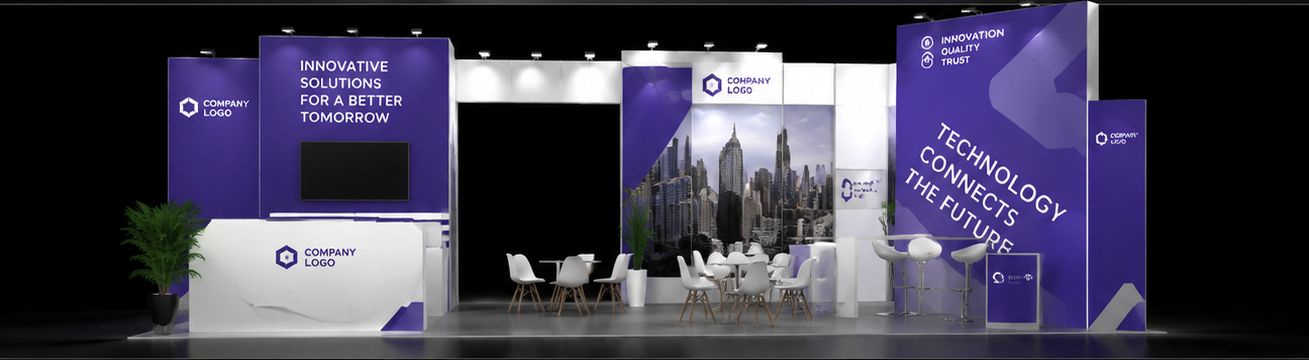
What is the core challenge of setting up a pop-up store in a shopping mall?Why are traditional booths not sufficient?
There is a fundamental difference between a shopping mall pop-up store and an exhibition: exhibitions typically allow one to two days for setup, while shopping malls often only allow a few hours. Most shopping malls require construction to begin after closing hours at night and to be fully cleared before opening the next day, leaving an actual setup window of only a few hours. This means there is almost no room for trial and error—any issue such as worker delays, missing parts, or size deviations can affect the normal opening.
Short time window: the setup time provided by shopping malls is usually only a few hours
Night construction combined with the hard deadline of next-day opening compresses the complete cycle of traditional booths, which is 'factory prefabrication—on-site assembly—post-event dismantling'. Wooden custom booths typically require several days from entry to dismantling, which clearly conflicts with the shopping mall's few-hour construction window;Although pull-up banner stands are portable, assembly and adjustment still take time, and it is difficult to complete the construction of complex structures in a short period.
Many site restrictions: central islands, side halls, and irregular areas place high demands on booth flexibility.
Shopping malls impose more restrictions on booths than exhibitions do. Common ones include:
- Floor protection requirements: Mall floors are mostly tiled or marble, and drilling, nailing, and cutting are prohibited. Traditional wooden custom booths require on-site sawing and fixing, which can easily violate this rule.
- Fire safety and traffic flow review: Booths must not block fire hydrants or evacuation routes. Top structures need to reserve space for fire sprinklers, and construction materials must provide flame-retardant certificates.
- Load-bearing and stability requirements: The central island area is unobstructed on all sides, so the booth must be independently resistant to tipping over;The side hall is against the wall but has limited height.
- Non-standard site shapes: The central island may be circular, triangular, or an irregular area with columns. Traditional booths are designed to standard dimensions, and on-site adjustments are often needed.
These constraints place higher demands on the flexibility and adaptability of the booth. Modular booths use aluminum alloy trusses with hand-tightened screws, requiring no power tools and without damaging the mall floor. The structural components can be repeatedly assembled and disassembled, and the dimensions and layout can be flexibly adjusted according to the actual site. Under the dual constraints of time windows and site limitations, this is a solution better suited to pop-up store scenarios than traditional booths.
How do modular booths solve the problem of rapid setup for pop-up stores?
The core contradiction of pop-up stores is "tight time, variable sites, and limited manpower." The construction window given by the mall is often only a few hours. Traditional booths require professional workers and specialized tools, while the design logic of modular booths is to simplify these time-consuming steps in advance.
Tool-free hand-tightening assembly: no professional workers needed, 1-2 people can complete it
The connectors of this booth use a hand-tightened screw structure, requiring no electric drills, wrenches, or any power tools. The operation method is to align the truss rods with the interfaces and tighten the screw caps by hand to secure them. There is no need to judge force or angle; when the screw cap is tightened to the end, it is locked.
This means that the assemblers do not need to be skilled workers; brand store staff or marketing colleagues can get started after a simple demonstration. Two people can work together, one holding the frame and the other tightening the screws, to complete the assembly. Compared to traditional welded or bolted booths, it saves hidden time costs such as tool preparation and waste cleanup.
Modular truss structure: flexible layout adjustment to adapt to different venues
The site conditions of pop-up stores vary—some mall atriums are square, some corridors are long and narrow, and some spaces need to work around fire hydrants or pillars. The core value of modular truss systems lies in 'disassembled as rods, assembled as structure,' allowing the width, depth, and height of the booth to be adjusted according to the actual site dimensions, rather than being limited by fixed sizes.
The same booth system can be repeatedly assembled and disassembled, flexibly adapting to different venues, reducing the investment in re-fabricating display fixtures each time the venue changes. The high-strength aluminum alloy frame provides a durability foundation for repeated assembly and disassembly, and combined with the modular structure, enables the booth to meet the needs of multi-venue tours.
In the pop-up store scenario, which advantages of modular booths are real? Which ones need to be confirmed?
The core demands of pop-up stores are 'quick to set up, easy to dismantle after use, and visually impressive enough to hold the scene.' Modular booths do have design-level advantages in these three directions, but some parameters can only be verified in your specific venue.
Real advantages: compact shipping volume, reusability, and support for custom brand graphics
These three advantages are directly determined by the product structure and do not depend on specific operating conditions:
- Compact shipping volume: The modular truss system, when disassembled, consists of rods and connectors, with a packed volume far smaller than that of a one-piece exhibition booth.For pop-up stores, this means they can use regular freight or even express delivery, without the need to arrange for large trucks.
- Reusability: The combination of an aluminum alloy frame with engineering plastic/carbon steel connectors is designed for multiple assembly and disassembly cycles.If a pop-up store has a multi-city tour plan, this system can travel with the brand, spreading the cost thinner per stop.
- Custom brand graphics: The truss structure supports printed graphic covering, with adjustable size and layout.This means the same frame can change graphics and color schemes in different shopping malls without needing to rebuild the structure.
Additionally, tool-free hand-tightened assembly is a real design feature, not marketing talk—it directly determines that on-site setup does not require professional workers; store staff or part-time personnel can complete it by following the instructions.
Need to confirm: specific load-bearing capacity and coordination requirements with mall property management
These two items cannot be unilaterally promised by the product; they depend on your actual usage.
What needs to be confirmed regarding load-bearing capacity: The product specifies a "high-strength aluminum alloy" frame and "reinforced engineering plastic + carbon steel" connectors, but load-bearing capacity is not a fixed value—it depends on the truss span, number of connection points, graphic material, and the weight of suspended items. You need to provide the following information to the current website team to get a matching solution:
- The weight and dimensions of the screen or lightbox you plan to hang
- The maximum span of the booth (for example, 3 meters or 6 meters)
- Whether personnel need to work or climb above the booth
Coordination requirements from the mall property: Entry standards vary significantly between different malls. Common points that need to be confirmed include:
- Whether the booth is required to provide fireproof certificates or material test reports (the product has CE certification, but some malls may additionally require domestic test documents)
- Entry time windows — some malls only allow overnight setup, which can affect your decision on the scale of the booth.
- Floor protection requirements — if the mall requires protective mats, you need to confirm whether the booth's base structure is compatible.
- Electrical approval — if the booth includes lighting or screens, the property management may require separate approval for circuit connections.
Next Steps
Before deciding whether to use a modular booth, do two things:
- List your pop-up store venue checklist, including each mall's setup time window, floor conditions, and electrical restrictions.
- Clearly list the items you plan to display.—Weight, dimensions, whether it needs to be suspended, and then take this checklist to confirm the load-bearing matching plan with the current venue team.
This way, you can quickly determine whether the "quick setup" advantage of modular booths holds true in your specific scenario, and where extra preparation is needed.
How to determine whether a modular booth is suitable for your pop-up store? Selection recommendations and boundaries
Modular booths are not a one-size-fits-all solution; they have their own applicable boundaries. The criterion is not "good or bad," but "suitable or not." Here are the conclusions directly.
Suitable for: multi-venue touring, unified brand image, and pursuit of long-term cost efficiency
If your pop-up store plans to tour across multiple malls or cities, modular booths are almost the first choice. The reasons are straightforward:
- High disassembly and assembly efficiency: With tool-free hand-tightened screw design, one person can complete the assembly and disassembly, and the single setup time is far shorter than that of traditional wooden booths.During the tour, what is saved is not just time, but also labor costs.
- Visual consistency: The modular frame is paired with replaceable brand graphics. Each time you change venues, you only need to update the graphic content, while the main structure remains unchanged, ensuring stable brand visual output.
- Long-term cost amortization: The initial investment is higher than one-time carpentry, but after 3 or more uses, the overall cost (production + transportation + setup + storage) is usually lower than remaking it each time.If you have multiple events within a year, this calculation makes sense.
- Transportation convenience: The aluminum frame, when disassembled, is compact and lightweight, and can be loaded into a regular truck or even an SUV, saving on large-scale logistics costs.
Not suitable for: one-time complex designs, frequent requirement changes, no storage space
In the following three situations, modular booths may not be the optimal solution:
- Pursuing one-time complex designs: If your pop-up store requires irregular structures, large curved surfaces, or immersive spatial experiences, modular booths (especially standard truss systems) offer less design freedom than custom carpentry.Its advantage lies in "regularity and repeatability," not in "uniqueness and wow factor."
- Frequent requirement changes: Every event requires changing layouts, swapping structures, and adjusting dimensions. Since the connectors and frame specifications of modular systems are fixed, frequent changes lead to a large number of idle accessories, which actually increases costs.
- No storage space: The value of modular booths is built on "reuse."If there is no warehouse to store them after the event, and they can only be discarded or resold, then the cost advantage no longer exists, making it no better than a one-time solution.
How should the budget be considered?
Don't just look at the initial purchase price. Following this approach, let's calculate the total cost:
| Cost Item | Modular Booth | One-time Woodwork |
|---|---|---|
| First Production | Higher | Lower |
| Second Use | Screen update fee only | Complete redo |
| Third use | Screen update fee only | Complete redo |
| Transportation | Lightweight, low cost | Bulky, fragile |
| Setup labor | Tool-free, minimal staff | Requires professional workers |
Conclusion: Using it once, modular is not cost-effective;Using it twice, roughly breaks even;Using it three times or more, modular is clearly more economical. If your pop-up store plan is for a single event with no follow-up arrangements, it is recommended to directly choose a one-time setup solution.
What information do you need to provide when consulting?
To help the team match you with an accurate solution, please prepare the following information when consulting:
- Site dimensions and floor height: Including booth area, height limit, and floor conditions (whether drilling is allowed).
- Number of events and cycle: How many times it will be used and the interval between each use, which directly affects whether investing in modularity is worthwhile.
- Display content: What products will be mainly displayed, whether load-bearing display tables are needed, and whether heavy objects need to be hung—this determines the frame specifications and accessory selection.
- Frequency of graphic changes: Whether graphics need to be changed for each event, and the graphic size and process requirements.
- Storage Conditions: Whether there is warehouse storage after the event, and how much space is available.
FAQ
Q: How much weight can a modular booth bear? Can it hold heavy products? A: The frame is made of high-strength aluminum alloy, and the connectors are reinforced engineering plastic plus carbon steel, so regular displays are no problem.
However, the specific load-bearing limit depends on the booth size, structural layout, and load-bearing positions. You need to provide the product weight and display method, and then the team can give an accurate load-bearing solution.
Q: Can the graphics be fully customized? Or is it still limited to standard sizes? A: The graphics can be custom printed, and the size and layout can be adjusted according to the booth space.
However, the graphics need to fit the frame structure, so it is recommended to produce the graphics after confirming the frame plan to avoid size mismatches.
Q: Can one person complete the setup? How long does it roughly take? A: It features a tool-free hand-tightened screw design, so no professional tools are required.
However, the setup time depends on the booth area and complexity. For small areas, one person can complete it, but for large areas, it is recommended that two people work together for greater efficiency. The specific time needs to be assessed based on your booth dimensions.
Q: What if there is no warehouse after the event? A: This is a key condition to confirm before choosing a modular booth. If there is indeed no storage space, the advantage of modular reuse cannot be realized. It is recommended to evaluate a one-time solution or discuss with the team whether there are rental or consignment storage options.
Q: What accessories are included in the standard package? What else do I need to purchase? A: The standard package includes the complete frame system, all connectors, and assembly accessories.
Display tables, lighting, graphics, etc., are optional accessories and need to be confirmed separately based on your display needs.
Learn More
If you are planning a pop-up store and are unsure whether a modular booth is suitable for your venue and event cycle, feel free to contact the Qingsuyu Exhibition Equipment team. Submit your venue dimensions, list of display items, and number of event sessions, and we will match you with a specific truss configuration and load-bearing solution.
Related Products:Custom Modular Truss Trade Show Booth | Tool-Free Quick Assembly Portable Exhibition System