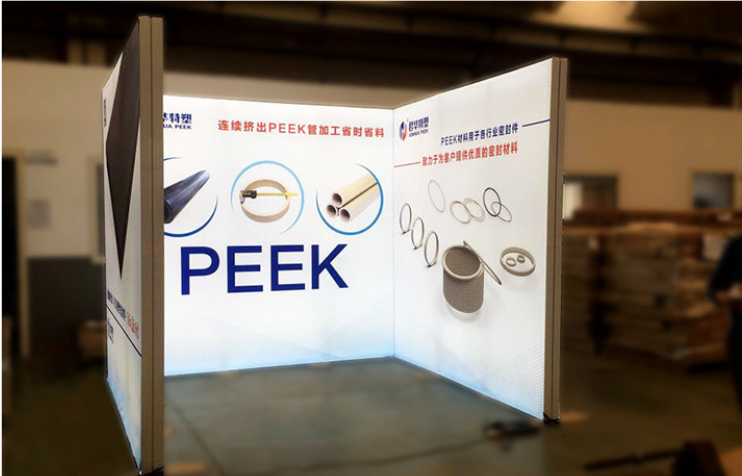
What is a modular exhibition booth?How does it adapt to different brand promotion activities?
If you need to participate in industry trade shows, mall pop-up events, and brand roadshows at the same time, redesigning and producing a booth each time makes it difficult to control budget and schedule. Modular exhibition booths solve this problem: using a set of disassemblable structural systems that can be reused across different event scenarios.
Core structure and assembly logic of modular truss exhibition booths
The main body of a modular exhibition booth isa high-strength aluminum alloy frame, and the connectors useThe combination of reinforced engineering plastic and carbon steel. Aluminum alloy tubes bear the load and maintain shape, engineering plastic connectors ensure lightweight and insulation, and carbon steel inserts provide the strength needed for threaded connections. Working together, these three materials keep the booth lightweight while maintaining structural stability.
In terms of assembly, this type of booth uses atool-free hand-tightened screwdesign. You don't need a drill, wrench, or any power tools—just insert the tubes into the connectors and hand-tighten the screws to secure them. A standard-sized booth can typically be assembled by two people within half an hour to an hour.
Disassembly is similar: simply unscrew the connectors in reverse and pull out the tubes, then pack them into the transport case.
Sturdiness depends on two conditions: first, the tightness of the connectors—once hand-tightened, the structure is stable;second, the overall dimensions and load-bearing design of the booth. For typical display items like light boxes, shelves, and screens, the modular truss system can support them. However, if you plan to hang heavy equipment or build multi-level structures, you need to inform your booth supplier of the specific load requirements in advance, and they will confirm whether the connector specifications and tube wall thickness are suitable.
From trade shows to pop-up stores: the capability limits of modular booths
The design logic of modular booths makes them naturally suitable for multi-scenario switching:
- Exhibition scenarios: The standard truss structure can be flexibly combined according to booth area (such as 3×3, 3×6 meters), and with customized graphic back panels, a brand image wall can be quickly built.
- Shopping mall pop-ups: The structure is lightweight and quick to assemble and disassemble, suitable for setting up during non-business hours and quickly dismantling after the event.
- Brand roadshows/corporate events: The height and width can be freely adjusted to adapt to different indoor and outdoor site conditions.
Its capability boundary lies inDegree of Customization。 Modular systems excel at combining standard structures with customized graphics—the framework is standard, but dimensions, layout, and printed graphics can all be tailored to your needs. If your requirements involve unconventional shapes, special material finishes, or complex lighting structures, modular systems may not be the optimal choice. Such needs are better suited for custom wooden or metal exhibition booths.
Who Should Use Modular Booths? Brand teams that participate in multiple events a year, want to reduce long-term exhibition costs, and need quick response times. **Who is it not suitable for?
** Brands that seek one-off unique designs, need to support ultra-heavy equipment, or require complex spatial designs should consider custom solutions.
Next, you need to confirm: your commonly used booth size, the weight of the exhibits you plan to display, and your annual frequency of use. With these three pieces of information, you can communicate with the booth supplier, and only then can they provide matching pipe specifications, connector configurations, and graphic production solutions.
Four Typical Scenarios: Which Brand Promotion Activities Are Suitable for Modular Booths?
The value of a modular booth lies not in being usable for "any activity," but in precisely solving the most troublesome problems in certain activity scenarios. Below, we break down four typical scenarios; you can judge based on your own situation.
Overseas Trade Shows and Industry Expos: Choices When Time Is Tight and Shipping Is Far
The core pain points of overseas exhibitions are twofold: first, high shipping costs, where the booth's volume and weight directly determine freight charges;second, compressed on-site setup time, as many exhibitions allow only half a day to a full day for booth installation.
Modular booths have clear advantages in these two areas. The aluminum alloy frame combined with engineering plastic connectors makes the overall weight far lighter than traditional wooden structures. When disassembled and packed into flight cases, the volume is manageable, significantly reducing international logistics costs. More importantly, it requires tool-free installation—hand-tightened screws secure the structure, eliminating the need for power drills, ladders, and professional assembly workers. Two or three people can complete the setup.
For overseas exhibition teams, this means avoiding extra local labor costs for assembly and reducing the risk of setup errors caused by communication issues.
Suitable for: If your team frequently participates in overseas exhibitions and each booth area is between 9 and 36 square meters, modular booths are a cost-effective choice. However, note that if your booth exceeds 50 square meters, requires multi-story structures, or involves extensive custom shapes, the complexity of modular system assembly increases, and its advantages diminish.
Shopping Mall Pop-up Stores and Brand Promotions: Flexible Layout and Quick Switching
Shopping mall pop-up stores are characterized by short cycles, varied locations, and high visual requirements. Today it's in the atrium of Mall A, and next week it may move to a side hall in Mall B, so the booth needs to be flexibly adjusted according to the site conditions.
This is where the customized structure of modular booths comes into play—the frame dimensions can be adjusted to the actual site, and the brand graphics can be changed at any time. More importantly, pop-up stores often need to be set up and dismantled overnight, and the tool-free quick-install design allows the team to efficiently complete the switch during the mall's non-business hours. Compared to one-time wooden booths that are discarded after use, modular systems can be repeatedly assembled and disassembled, spreading the cost lower per event.
Suitable forSuitable for brand teams with more than 2 short-term events per month. If your pop-up store plan is once every six months and the site conditions vary greatly each time, renting a booth may be more cost-effective than buying—this requires you to calculate based on the frequency of your events.
Corporate New Product Launch: Consistent Image and Reuse
The exhibition area for a new product launch is usually divided into a product experience zone, a brand image zone, and a negotiation zone. The advantage of modular booths is that the same frame can be adapted to different venue requirements for product launches by changing graphics and adjusting the layout. For companies with multiple launches a year, a reusable booth system can better ensure brand visual consistency while avoiding the need to redesign and rebuild each time.
Brand promotional events: lightweight deployment and rapid response
Activities such as mall atrium promotions, outdoor roadshows, and community outreach have widely varying venue conditions and short setup windows. The lightweight and quick-assembly features of modular booths allow teams to flexibly handle last-minute changes—for example, moving from outdoor to indoor due to weather, with the booth layout quickly adjusted. For brands with frequent promotional activities, this system can significantly reduce material costs per event.
Next step to confirm: Compare with your event plan, count the number of exhibitions/events in the next 12 months, the booth area per event, and transportation distance, then provide these data to our team. We can help you determine whether a modular booth is more cost-effective than one-time construction or rental.
In which situations is a modular booth not recommended?Selection boundaries and budget judgment
Unsuitable scenarios: unclear requirements or pursuit of one-off complex designs
Modular booths are not suitable for all scenarios. It is recommended to be cautious in the following two situations:
It is not recommended to purchase when requirements are unclear. If the frequency of participation, booth area, and display content have not been determined, or the plan is still being frequently adjusted, the reusable advantages of a modular booth cannot be realized, and the payback period for the investment is unclear. It is recommended to first clarify the exhibition plan for the next 12 months before deciding whether to purchase.
When pursuing a one-time complex shape, traditional custom-built booths are more suitable. Modular booths use a standardized frame system, with customization mainly reflected in dimensions, layout, and brand graphic printing; they cannot achieve non-standard shapes with sculptural, irregular forms. If a brand requires completely different visual impact at each exhibition with no reuse plan, traditional custom-built booths have an advantage in shape flexibility.
How to calculate the budget: reuse value vs. initial investment
Which is more cost-effective between modular booths and traditional custom-built booths depends not on unit price comparison, but on the number of uses.
| Judgment dimensions | Modular booths | Traditional custom-built booths |
|---|---|---|
| Initial investment | Higher (purchasing the entire frame system) | Single cost is controllable, but each redo |
| Cost of secondary use | Only need to update graphics | Redesign + production, costs start over |
| Suitable scenarios | Exhibiting 2+ times per year, multi-city roadshows | For a single large-scale exhibition with an ample budget |
When the budget is limited, it is recommended to prioritize the reusability of the booth and transportation costs. The higher the frequency of events and the more varied the venues, the more obvious the effect of amortizing the unit cost of modular booths. At the same time, warehouse space and cross-city transportation costs should be included in the total account to comprehensively evaluate the return on investment.
How to determine whether a modular booth is suitable for your event? Three-step decision-making method
Many teams tend to fall into a misconception when choosing a booth: they first look at whether it looks good, and then ask whether the price is cheap. But whether a modular booth is suitable for you is truly determined by your own event pace and logistical conditions. The following three steps will help you clarify the issue.
Step 1: Take stock of the annual event frequency and venue types
First, answer a question: How many exhibitions or brand events do you attend in a year? Is the venue fixed or does it change frequently?
- Attending 1-2 exhibitions per year, and always at the same venue: Traditional custom booths may be more cost-effective, as construction costs can be amortized, and you don't need to pay extra for portability.
- Attending more than 3 exhibitions per year, or venues change frequently: The advantages of modular booths begin to show.Its core value lies in reuse—each time, the saved labor and transportation costs for setup accumulate into a significant figure.
- For non-standard venue needs such as pop-up stores, mall atrium events, and brand roadshows, the variable layout capability of modular booths deserves special attention.These event venues vary greatly in shape and size, so products with flexible structural adjustments are far more practical than fixed-size booths.
Step 2: Evaluate Transportation and Storage Conditions
This is the most easily underestimated step, yet it can determine success or failure. First, confirm two specific conditions:
Transportation: The modular booth uses an aluminum alloy frame with detachable connectors, and its disassembled volume is much smaller than the overall structure. But you need to confirm: can your vehicle's trunk or cargo compartment accommodate the longest single rod member after disassembly? If you have to rent a large truck for every transport, the cost advantage of transportation will be offset.
Storage aspect: The disassembled modular booth still requires a fixed storage space. It is recommended that you actually measure the available area in your company's warehouse or office and compare it with the packaging dimensions of the disassembled booth. If even storage is a problem, no matter how good the reusable design is, it cannot be implemented.
Step 3: Clarify customization boundaries and assembly conditions
Regarding the degree of customization, you need to distinguish between two levels:
- Structural dimensions: The modular truss system supports customization of length, width, and height, and can adapt to booths of different sizes.This aspect offers high flexibility.
- Visual graphics: Brand graphics, banner cloth, lightbox films, etc., can be printed on demand and mounted on the truss.However, note that changing graphics requires re-producing materials, and this cost and lead time should be included in the budget.
In terms of assembly, this product features a tool-free hand-tightened screw design, requiring no professional tools such as electric drills. But "tool-free" doesn't mean "zero experience"—for the first setup, plan for 30% more time than expected to let the team get familiar with the connection sequence. If you have long-term assembly workers, have them learn on-site once during delivery, and subsequent efficiency will improve significantly.
Summary judgment: If you have high event frequency, varied venues, and fixed storage space, modular booths are a direction worth serious consideration. If you only exhibit occasionally and have no storage conditions, traditional disposable booths may be more hassle-free. When unsure, list the three conditions above as a checklist and tick them off one by one—the answer will naturally become clear.
FAQ
Q: Can modular booths be built as a two-story structure? A: This product is currently positioned as a single-layer modular truss system, mainly for standard booths and brand display scenarios. If you need a double-layer structure, you will need to additionally confirm the load-bearing design and approval requirements. We recommend that you directly explain your specific floor height and area requirements to our team, and we will determine whether the existing system can meet them.
Q: How many people and how much time are typically needed to assemble and disassemble the booth once? A: This depends on the booth area and the team's proficiency. The tool-free design saves time spent looking for tools and tightening screws, but the first assembly will be slower as you need to follow the instructions while working.
We recommend setting aside half a day for the first time; subsequent assemblies will be noticeably faster. For your specific booth dimensions, you can consult us for a more accurate estimate.
Q: Are the graphics and lighting included in the standard configuration? A: The standard configuration includes the truss frame system, connecting hardware, and assembly accessories. Graphic printing, lighting, display cabinets, etc., are optional accessories and need to be confirmed separately.
We suggest you mention the quantity of products to be displayed and your lighting requirements when consulting, and we will provide a complete configuration list.
Q: Is this booth suitable for outdoor events? A: The aluminum alloy frame itself has good weather resistance, but for outdoor use, you also need to consider wind reinforcement, ground flatness, and waterproofing for the power supply. If you have plans for outdoor events, please inform us of the venue conditions in advance, and we will assess whether additional counterweights or other reinforcement solutions are needed.
Q: If our company adopts a new brand visual identity next year, can the booth still be used? A: Yes. The visuals of a modular booth are independent of the structure, so brand updates can be completed by replacing the graphic materials, while the main structure can continue to be used.
This is also one of the reasons why modular booths are more economical than one-time booths in long-term use.
Learn More
If you are planning your exhibition or event schedule for the next year, feel free to share with us your event frequency, booth size, and product load requirements. We will help you assess whether a modular booth is suitable and provide matching configuration recommendations.
Related Products:Custom Modular Truss Trade Show Booth | Tool-Free Quick Assembly Portable Exhibition System