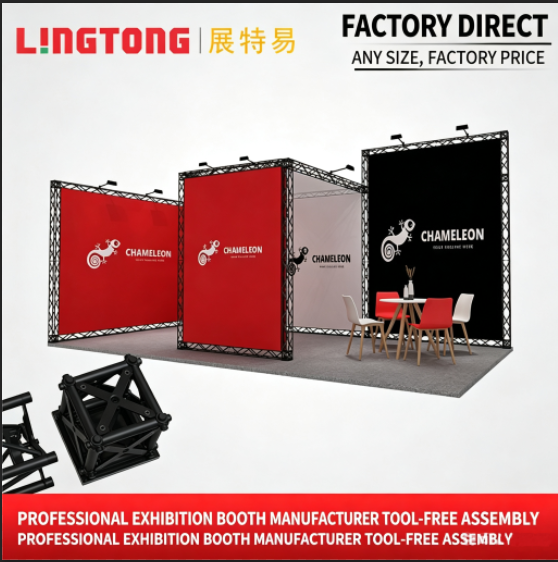
What is a modular exhibition booth?How does it achieve portability and quick assembly?
A modular exhibition booth, simply put, breaks down a traditional booth into a set of standardized "building blocks"—aluminum alloy truss rods, engineering plastic connectors, and decorative panels. You don't need a drill, wrench, or glue; you can assemble the loose parts into a complete booth with just hand-tightened screws. The core problem it solves is: **transforming a booth that requires multiple people, multiple tools, and multiple days to build into something that two people can complete in half an hour with bare hands.**
**
Modular truss structure and tool-free assembly principles
The assembly logic of a modular exhibition booth is not complicated. The entire structure consists of two basic elements:
- Truss members: Hollow tubular structures made of high-strength aluminum alloy, with cross-sections typically square or triangular, featuring regular holes or grooves on the surface for connecting and hanging panels.
- Connectors: Joints made of engineering plastic or carbon steel, responsible for fixing the members together at corners and intersections.
During assembly, you only need to insert the members into the corresponding interfaces of the connectors, and thenhand-tighten the locking nuts or handles on the connectors。 no power tools or professional workers are required. The overall process is roughly as follows:
- Assemble the base frame by connecting the rods and connectors on the ground area according to the drawings;
- Erect the corner columns and lock them in place with horizontal rods;
- Attach decorative panels or light boxes, and finish the top closure.
The whole process is like assembling a large piece of furniture, but simpler than furniture—because each connector corresponds to only one installation method, and if the direction is wrong, it won't fit in, which itself is a foolproof design.
Design Logic of High-Strength Aluminum Alloy and Engineering Plastic Connectors
You might worry: without tools, without welding, just by hand tightening, can the structure be stable? This requires understanding the logic of material division of labor:
- The aluminum alloy truss is responsible for load-bearing。Aluminum alloy has a high strength-to-weight ratio, and the truss structure itself distributes stress across the entire frame through triangular or grid-like arrangements.The weight of lightboxes, displays, and decorative panels borne by the booth is mainly supported by the truss.
- Engineering plastic connectors are responsible for positioning and locking.。Inside the connectors are precision grooves and threaded structures; once hand-tightened, a tight mechanical interlock forms between the rods and connectors.Carbon steel inserts are used at the most stress-bearing nodes to prevent plastic parts from deforming under long-term pressure.
However, "sturdiness" comes with conditions. The stability of a tool-free assembled booth depends on three factors: whether the ground is level, whether all connectors are fully locked into place, and whether the booth's height and span are within the safe range of the structural design. If you need to build a two-story structure over 4 meters high, or hang a heavy LED screen, you cannot simply rely on standard connectors—additional reinforcement solutions are required.
Who is this type of booth suitable for? If you are participating in a standard 9-square-meter or 18-square-meter booth, and the display content is mainly graphics, light boxes, and lightweight products, modular booths are fully sufficient. **Who is not suitable?
** If you need to build a two-story custom booth, or need to support the display of machinery weighing hundreds of kilograms, please confirm the load-bearing solution with our team first, rather than directly applying standard modules.
Next step for confirmation: Tell our project team the weight of the products you plan to display, the booth dimensions, and the number of people for setup. Based on these conditions, we will determine whether standard modules meet your needs or provide a reinforcement solution.
In touring display scenarios, what practical problems do modular booths solve?
Pain points of transportation and storage for multi-city touring exhibitions
The most underestimated cost of multi-city roadshows is not the booth itself, but logistics and warehousing. Traditional wooden booths are basically fixed once assembled; moving to another city means disassembly, repacking, and on-site repairs for damage caused by bumps during transport. What's more troublesome is that after the roadshow ends, these booths often have nowhere to store them—renting a warehouse is a continuous expense, and discarding them directly wastes the initial custom investment.
Modular booths have structural advantages in these two aspects. The aluminum alloy frame combined with a modular truss system, when disassembled, consists of standardized rods and connectors that can be tightly packed into a regular box truck, fitting much more than a whole booth in the same transport volume. During storage, loose parts stack up taking less space, so renting a small warehouse is sufficient.
For teams doing 5-8 city roadshows a year, the savings on logistics and warehousing can typically cover part of the booth investment itself.
Time pressure of on-site setup for new product launches
The setup window for a new product launch event is often measured in hours. The venue may host other events the night before, and doors open the next morning, leaving only 4-6 hours for booth setup. Traditional booths require multiple workers, specialized tools, and on-site coordination; if any step is delayed, the entire launch rhythm is disrupted.
The core value of modular booths lies in tool-free quick assembly. Connectors use hand-tightened screw designs, requiring no tools other than a drill, wrench, or ladder; ordinary marketing or brand staff can complete assembly with simple guidance. For a standard 3×3 booth, two people can typically complete the main frame assembly in 1-2 hours, leaving time for graphic installation and product display.
This means you don't need to hire additional setup workers and reduce dependence on venue construction time.
Who is this suitable for?: Small and medium-sized enterprises that have a fixed touring exhibition plan and need to control logistics and warehousing costs;Situations where the event preparation team has limited manpower and does not want to rely on external booth builders.
Who it is not suitable for: Booths that pursue oversized and complex shapes, requiring multi-layer structures and special load-bearing capabilities;High-end brands with extremely high design requirements for the surface texture of the booth—modular trusses are more suitable for a clean and modern style, while complex and irregular shapes still require custom solutions.
Next steps to confirm: If you plan to use it for multi-city touring exhibitions, it is recommended to confirm the single-box dimensions and total weight of the disassembled parts with the current website team to estimate logistics costs;If it is for an event, confirm your booth area and ceiling height restrictions to determine whether the standard modules can match the on-site space.
What types of events are modular booths suitable for?In which scenarios are they not recommended?
To determine whether a modular booth is suitable for your event, focus on three key conditions:Frequency of use, venue constraints, and display duration。
Typical suitable scenarios: trade shows, pop-up stores, product launches, and brand promotions
Trade shows and industry exhibitionsare the most common application scenarios for modular booths. Such events typically last several days and require quick setup and teardown. The modular booth is assembled with tool-free hand-tightened screws, requiring no professional construction team. Enterprises can complete the setup themselves, eliminating the welding, carpentry, and painting processes of traditional custom booths, and avoiding the high construction management fees charged by exhibition halls.
Modular booths are suitable for shopping mall pop-up stores. The typical characteristics of pop-up stores are short cycles, unfixed locations, and the need for frequent venue changes. The aluminum alloy truss structure of the modular booth is lightweight, easy to transport after disassembly, and has low relocation costs.
If you plan to tour multiple shopping malls, the same booth can be reused repeatedly, and the amortized cost per use will be lower than making a new wooden booth each time. In addition, the modular structure supports customized dimensions and brand graphic printing, allowing layout adjustments according to the space of different shopping malls.
New product launches and brand promotional activitiesare also suitable. Such events often last only one day or even just a few hours, leaving an extremely short window for on-site setup. Modular booths can be assembled without tools, making them suitable for temporary functional areas such as press conference backdrop walls, product display zones, and registration desks.
Scenarios requiring careful evaluation: long-term fixed displays and oversized custom booth requirements
For long-term fixed displays (exceeding 3 months), modular booths are not the recommended priority. If your exhibition hall requires long-term use, fixed booths are typically superior in terms of material texture, integrated lighting, and storage space design. The advantage of modular booths lies in their 'disassemblability,' but if you never take them apart, this advantage is wasted, and you end up making design compromises for the sake of a demountable structure.
Oversized custom booth requirements need careful evaluation. Although modular truss systems can be joined together, extra-large spans, cantilevered structures, and special shapes impose higher demands on structural calculations and counterweighting. If your booth requires a two-story structure, a large suspended ceiling, or a complex lighting system, traditional custom construction may be more mature.
However, if your needs are only 'large area but simple structure' (for example, a long backdrop wall plus a few display tables), modular booths are still feasible—the key is to confirm the specific dimensions and structural requirements with the team, and determine whether the truss specifications and connectors meet the load-bearing requirements.
Next step for confirmation: If the event you are planning falls into the 'cautious evaluation' range, please provide three pieces of information—booth area, estimated number of usage days, and whether heavy items (such as screens or light rigs) need to be suspended. We will help you confirm whether the modular solution meets the requirements based on the truss specifications and connector parameters.
How to determine whether a modular booth is worth the investment? Budget and selection recommendations
Evaluate return on investment based on event frequency and venue changes
To determine whether a modular booth is cost-effective, focus on two key variables:Event frequencyandvenue variability。
The initial procurement cost of a modular booth is typically higher than a one-time rental of a traditional booth, but its value lies in the ability to be repeatedly assembled, disassembled, and reused. If you participate in more than three exhibitions a year, or the same booth needs to be displayed across multiple cities, the amortized cost per use decreases with each additional use, making the return on investment more apparent. Conversely, if there is only one exhibition per year with no plans for subsequent use, the advantage of reuse cannot be realized, and a one-time rental or traditional solution may be more straightforward.
Venue variability is equally critical. Modular booths support size adjustments and layout reconfiguration, making them suitable for scenarios where booth space varies between different exhibitions. If the booth size is fixed every time and the venue conditions are uniform, flexibility becomes an unused feature, and paying extra for it is not cost-effective.
In what situations should you choose a modular booth, and in what situations should you choose a traditional solution?
Situations where a modular booth is recommended:
- Participating in exhibitions more than 3 times a year, or needing to tour multiple locations
- The booth area varies between different exhibitions, requiring flexible layout adjustments
- Frequent changes to brand graphics are needed; modular frames with custom graphics allow for low-cost updates
- Portability is a priority, and you want to control transportation and storage costs
Situations where a modular booth is not recommended:
- Only one exhibition per year, with no follow-up activity planned.
- Extremely high design requirements for the booth structure, requiring irregular shapes or special material effects (modular booths are based on straight-line frames, offering less design freedom than fully custom woodwork).
- Very tight budget, with no intention of reuse.
Budget allocation recommendations: Prioritize reuse value and transportation costs. The initial investment for a modular booth may be higher than a one-time booth, but long-term use can amortize the cost. If you fall into the "possibly suitable" range, it is recommended to provide the supplier with your annual exhibition plan, typical booth area, and touring schedule to obtain a cost comparison estimate between modular and traditional solutions, and make decisions based on real data.
Frequently Asked Questions
Q: Which is more cost-effective, a modular booth or a traditional wooden custom booth? A: It depends on the frequency of use. For single-use scenarios, traditional wooden custom booths or rental solutions are usually more economical;however, if used more than 3 times a year, the advantage of reusability of modular booths gradually becomes apparent, with the per-use cost decreasing as the number of uses increases.
It is recommended to calculate the total cost based on your annual exhibition plan before making a comparison.
Q: Can modular booths accommodate different booth sizes? A: Yes. The modular truss structure supports customized dimensions and layouts, but different size combinations may require truss rods of varying lengths.
If you need to switch between multiple sizes, it is recommended to confirm all alternative sizes with the supplier at the time of purchase to ensure that one configuration can cover all usage scenarios.
Q: Does tool-free installation require any specific qualifications for operators? A: This booth uses hand-tightened screws for connection and does not require professional tools such as electric drills or wrenches. However, the first assembly must be done according to the instructions, and after familiarizing with the process, it can be completed by 1-2 people. If no one in the company is willing to learn the assembly, outsourcing the setup each time will incur labor costs that offset some of the savings from modularization.
Q: Is the modular booth suitable for outdoor events? A: This product is mainly designed for indoor temporary display scenarios such as trade shows, mall pop-ups, and corporate events. For outdoor use, the impact of wind and weather on the stability of the truss must be considered. If there is an outdoor need, it is recommended to confirm with the supplier in advance whether counterweight or reinforcement solutions are available.
Learn More
If your team is planning a multi-city roadshow or new product launch event and wants to evaluate whether a modular booth suits your booth size, product weight, and setup conditions, you are welcome to submit your annual exhibition plan or specific working conditions. We will help you confirm whether standard modules meet your needs based on truss specifications and connector parameters, or provide reinforcement and customization suggestions.
Related Products:Custom Modular Truss Trade Show Booth | Tool-Free Quick Assembly Portable Exhibition System