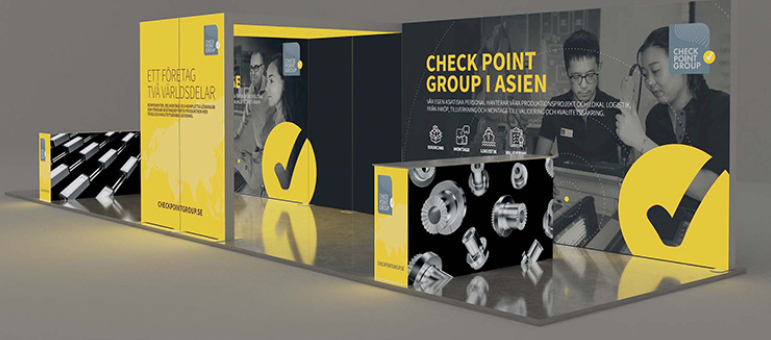
What exactly is an SEG lightbox booth: why can it be tool-free and set up by one person?
An SEG lightbox booth is a modular fabric backlit lightbox, not a traditional wooden structure or truss booth. It turns "setup" from construction into assembly: completely tool-free, relying on snap-fit and magnetic connections, one person can complete the assembly.
How the SEG fabric backlit lightbox works: silicone strip insertion + modular assembly
Silicone strips are sewn into the four edges of the graphic and inserted directly into the profile grooves. The tension of the silicone strips pulls the fabric surface flat, so after installation it is smooth, wrinkle-free, and has no visible seams. The profiles are joined into modules through snap-fit or magnetic connections, and then combined into a full wall, corner, or freestanding island. A single panel can be assembled in as fast as 10 seconds, and the entire booth can be set up within 8 minutes.
Tool-free does not mean simple structure: how snap-fit and magnetic assembly can be more reliably stable
Tool-free assembly relies on profile clips and magnetic positioning to achieve splicing, rather than depending on screws or external tools. The clips automatically engage upon insertion, providing structural rigidity and reducing the risk of the entire lightbox face becoming misaligned due to slight impacts;The magnetic components are responsible for quick alignment and edge finishing, making them suitable for graphic areas that require repeated disassembly and assembly and high seam precision. With both combined, no screws need to be tightened during installation, and the frame is in a locked state once assembled.
After the silicone strips on the graphic side are inserted, the fabric surface is evenly stretched while applying inward tension to the frame, further reducing wobbling.
One person sets up the booth in 8 minutes: what are the four steps of unboxing, splicing, attaching the fabric, and powering up?
At the exhibition hall, what people fear most is not that the exhibits have not arrived, but that there are not enough people to set up. The setup logic of this modular SEG fabric lightbox is to eliminate all three variables: waiting for people, waiting for tools, and waiting for hoisting. One person, two hands, zero tools—just follow the four steps below.
From unboxing to powering on: the complete steps for one person to set up a SEG light box booth
Step 1: Unbox and sort. Folding profiles and rolled-up fabric graphic panels are stored in separate boxes. Open the boxes, group and stack the profiles by number or length, stand the graphic scrolls upright against the side, and avoid stepping on them.
Step 2: Snap-on/magnetic assembly. The profiles are connected by snap-on or magnetic connections; no screwdriver, wrench, or any tools are needed. Align the connectors and push in to lock.
First assemble the base and uprights, then extend the horizontal modules; the skeleton of the entire booth takes shape at this stage.
Step 3: Insert the fabric graphic. The silicone strip of the SEG graphic is pressed directly into the groove of the profile frame, and it can be pushed in along the edge. When operating alone, first secure the two upper corners, then press the edges downward step by step; this is less laborious than pulling hard from one corner.
Step 4: Power-on inspection. Connect power only after the skeleton and graphics are in place. Confirm block by block that the LED backlight is lit and the brightness is even, and check whether the routing of the power cord affects audience flow.
The outdoor model supports IP54 waterproof rating, but the wiring port still needs protection confirmation according to on-site conditions.
Fastest single panel in 10 seconds, full set in 8 minutes: which designs make this efficiency possible
- Tool-free connection: Snap-on/magnetic attachment replaces screws, eliminating tool preparation and tightening actions, so one person can complete assembly.
- Modular splicing: The profiles can be folded for storage, and modules can be freely combined. A single panel can be assembled in as fast as 10 seconds, and the entire booth can be set up within 8 minutes.
- Pre-installed LED backlight: The backlight module is pre-installed inside the profile, requiring no on-site wiring or debugging, and it lights up as soon as power is connected.
If the on-site floor is uneven, the ceiling height is limited, or modules need to be spliced beyond the usual height, the 8-minute premise will change. In such cases, it is recommended to send the site dimensions and module combination method to our team in advance, to confirm whether the profile thickness (60mm / 85mm / 120mm) and splicing scheme match, and then decide whether auxiliary manpower is still needed on site.
Are tool-free structures really stable: How to judge on-site stability at exhibitions and common misconceptions?
What people fear most at the exhibition hall is not slow installation, but feeling uncertain after it is done. Whether a tool-free structure can withstand a three-day exhibition depends on what it relies on for load-bearing, not on the three words "tool-free."
Where does the stability of snap-fit/magnetic splicing come from?
Tool-free does not mean unconstrained. The stability of SEG light boxes usually comes from a three-layer coordination: the rigidity of the profile itself, the positioning and locking provided by snap-fit or magnetic parts, and the tension pullback formed on the frame after the silicone strip is inserted. If any one of the three is loose, it will show on site as wrinkled graphics, misaligned seams, or the entire surface shaking.
When judging, don't just look at whether it can stick; look at three on-site conditions:
- Ground and back wall: Carpet, slopes, and glass curtain walls all change the way the base bears force, and the stability feels completely different when placed against a wall versus standing independently.
- Splicing scale: A single panel and multiple panels connected in a row are two different structures.The more panels there are, the greater the accumulated error and the larger the wind-facing area, and the higher the requirements for connector consistency.
- Foot traffic and passage location: Main passages and corner positions have a high probability of being touched, so stability should be evaluated based on "being touched" rather than "no one touching it."
Three common misconceptions about tool-free light boxes
Misconception 1: Tool-free means unstable. Stability is determined by structural design, not by whether screws are used. The real question is whether the connectors can still maintain positioning accuracy after repeated assembly and disassembly.
Misconception 2: The more magnetic attachments, the more stable. Magnetic attachments are responsible for positioning and alignment, while load-bearing and lateral shift resistance still depend on the profiles and the base. Piling on too many magnetic attachments may instead make the assembly sequence more complicated and make single-person operation more difficult.
Misconception 3: If it does not wobble after installation, then everything is fine. Temperature changes at the exhibition site, air conditioning airflow, and construction vibrations from adjacent booths can all change the state after the show opens. Stable after installation does not mean it will still be stable on the third day.
What to confirm with the team before placing an order
Putting the question into specific conditions is more useful than asking "is it stable?": whether your booth is an independent island or against a wall, what the total width and height are, what material the floor is, and whether it needs to be used outdoors or semi-outdoors. These conditions will directly affect which profile grade to use, what base to pair with it, and whether additional counterweights or guy wires are needed. Tell the contact team these details and let them provide a splicing and fixing plan based on your site conditions. This is less troublesome than making fixes on site afterward.
Who this SEG light box booth is suitable for and who it is not: profile selection, graphic customization, and reuse boundaries
If you need to set up a brand wall at an exhibition site with minimal manpower and will need to use it repeatedly in the future, this modular SEG light box booth is worth prioritizing. Its core value lies in tool-free single-person assembly and foldable cyclic reuse, both of which directly affect the logistics and labor costs of cross-border exhibitions.
Recommended use cases:
- The exhibition team is short-staffed, and there are no local setup workers or tools on site.
- Exhibiting multiple times a year, hoping to reuse the same structure repeatedly.
- Needs a backlit brand wall, product display wall, or the visual centerpiece of a pop-up store.
- The graphic content needs to be quickly replaced for different exhibitions.
Not recommended use cases:
- Pursuing a one-time ultra-low procurement cost and not planning to reuse.
- Requires complex irregular structures or load-bearing hoisting
- Long-term outdoor fixed installation (non-IP54 outdoor model)
How to choose between 60mm/85mm/120mm: matching profile thickness to scenarios
| Profile thickness | Applicability assessment |
| 60mm | Small standalone light boxes, desktop or close-range displays, not sensitive to thickness |
| 85mm | Core flagship model, suitable for most booth walls and standard exhibition scenarios |
| 120mm | Large-area walls, requiring stronger structural presence and long-distance visual impact |
The key to selection is not "the thicker the better," but rather the graphic size and viewing distance. 85mm covers most exhibition scenarios;When a single graphic panel is relatively large or serves as the main backdrop wall, then consider 120mm.
Criteria for custom graphics, outdoor use, and repeated reuse
Graphics support fully customized printing, and after silicone strip inset installation, they are flat and wrinkle-free. Before customization, it is necessary to confirm the artwork file specifications, the alignment method at the joints, and whether a reserved area for the lightbox frame to cover is needed.
For outdoor use, it must be clarified: the standard model is mainly for indoor use, while the outdoor model supports an IP54 waterproof rating. IP54 does not mean it can be exposed to strong wind and rain for long periods. Before fixed outdoor installation, the specific protection plan should be confirmed with the team.
The boundary of repeated reuse lies in replacing the graphics rather than replacing the structure—the profiles and LED modules can be reused, and the graphics only need to be reprinted according to the exhibition theme. This is the core logic by which it dilutes the cost per use.
Frequently Asked Questions
Q: Can the graphics be fully customized according to my brand design? Yes, all SEG fabric surfaces support fully customized printing. Design files need to be provided and the splicing and blocking method confirmed.
Q: Can it be used at outdoor exhibitions? The outdoor model supports IP54 waterproofing and is suitable for sheltered outdoor scenarios. For long-term exposed installation, protection details need to be confirmed with the team.
Q: How many times can one set be reused? The profiles and LED modules are designed for repeated use. The actual lifespan depends on transportation and storage conditions. It is recommended to confirm storage and maintenance requirements with the team.
Q: Do you accept small-batch orders? Standard light box panels support a minimum order of 1 set, and small-batch orders are accepted.
Learn more
If you are selecting a model for your next exhibition, or want to confirm whether the floor conditions, ceiling height, and splicing scale of your existing venue are suitable for quick single-person setup, you can send your booth dimensions, usage environment, and number of graphics to our team, and we will help match the profile thickness and splicing solution accordingly.