Comparing self-purchase and local rental is not just about the quote: what a 3×3m SEG light box booth is, and where the cost difference comes from
When many teams compare prices for the first time, they put the "quote for renting a booth locally once" and the "purchase price of buying a booth outright" in the same table, and then conclude that "renting is cheaper" or "buying is more cost-effective." This comparison method barely works when you only do one show a year, but it becomes distorted when you do multiple shows—because the two are not the same cost structure at all.
What parts make up the 3×3m modular light box booth of the QingSuYv QSY-BX BOX Booth?
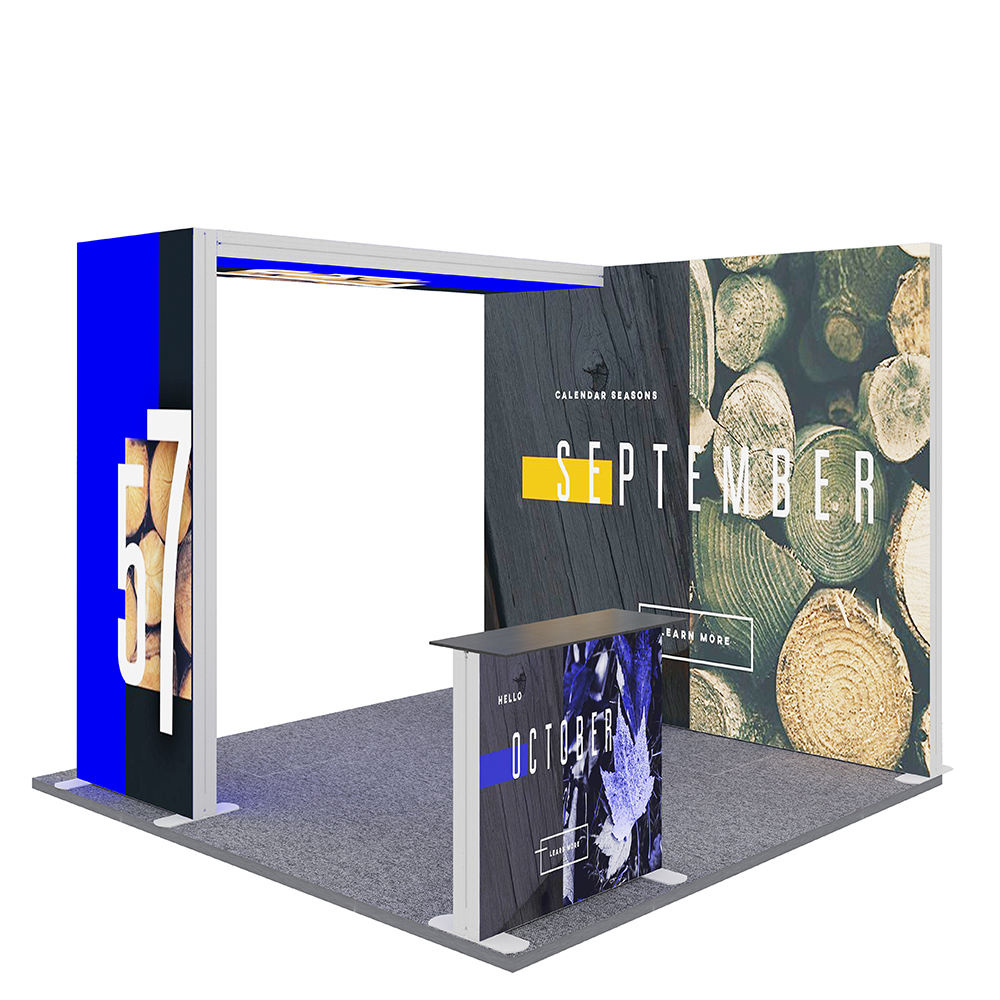
The QingSuYv QSY-BX BOX Booth is a 3×3 meter (10×10 ft) modular LED backlit booth. Its main body consists of an aluminum alloy frame, UL94 V-0 flame-retardant PVC light box fabric, and 120mm thick light box units, and it integrates a reception counter for lead capture. Double-sided graphic pillars let both aisles see the brand visuals. The entire structure is tool-free to assemble, the official assembly time is within 30 minutes, and the frame can be reused across multiple exhibitions. The product is aimed at exhibition, pop-up store, and shopping mall promotion scenarios in North America, Europe, and the Middle East. It supports straight and curved shapes, and the size can also be expanded to 10×20 ft, 20×20 ft, or customized.
In other words, what you are buying is not a "one-time setup service," but a set of physical assets that can be repeatedly disassembled and reassembled. What you get from renting is a one-time setup + dismantling + on-site support, and the asset never belongs to you.
Why a single rental quote cannot be directly compared with the purchase price of buying your own
The two have different cost scopes:
- A rental quote usually includes: the structure usage fee for a single exhibition period, local labor for setup and dismantling, on-site emergency support, and transportation to the venue.These costs are incurred again for every show.
- The self-purchase scope usually includes: the purchase price, first-time international shipping and customs clearance, storage and local transportation for each show, labor for setup at each show (or setup by your own team), graphic replacement, wear and tear, and repairs.
Subtracting these two sets of numbers directly is equivalent to comparing "the operating cost of one show" with "the purchase cost of one set of assets." What really needs to be established is, under the same basis,the total cost of multiple shows: for self-purchase, it is "purchase price + number of shows × operating cost per show"; for rental, it is "number of shows × price quote per show." The more shows there are, the thinner the fixed cost of self-purchase is spread, and the more burdensome the linear cost of rental becomes.
Before breaking down the specific variables, you need to first confirm one premise: whether your booth visuals need to be changed for every show, whether your target market is fixed, and whether you have available local warehousing. These three items will directly determine how low the per-show operating cost of self-purchase can be pushed. If these conditions are still unclear, it is recommended that you first explain your exhibition frequency and target market to the QingSuYv team, confirm the corresponding configuration and logistics plan, and then proceed to the next step of item-by-item breakdown.
Can a standard 10×10ft inline booth accommodate it: adaptability and compliance boundaries of a 3×3m light box booth
The nominal size of the 3×3m light box booth (QSY-BX BOX Booth) is exactly 10×10ft, basically aligning with the footprint of a standard inline booth. But "fitting" and "passing review" are two different things and need to be judged separately.
What the 3×3m layout, 120mm thickness, and 2.5m maximum height mean for booth adaptability
In terms of footprint, 3×3m and 10×10ft (about 3.05×3.05m) are almost identical, so at the booth area level it usually will not exceed the limit. What really needs to be checked are three boundaries:
- Thickness: the light box thickness is 120mm.If the booth has partitions on three sides or is adjacent to neighboring booths, the 120mm along the wall side will occupy aisle or back panel space, and it is necessary to confirm the organizer's permitted method for attaching to the back wall.
- Height: maximum height 2.5m.Most exhibition halls have height limits for inline booths. Whether 2.5m is within the limit and whether additional structural drawings need to be submitted depends on the rules of that exhibition hall and cannot be generalized.
- Structural form: the frame is rectangular or square, including a reception desk and double-sided light box columns.Whether the protruding parts of the reception desk and light box columns count toward the booth boundary needs to be confirmed according to the organizer's definition of "booth clearance."
Simply put: the footprint dimensions can be directly judged as matching;Whether the thickness, height, and protruding structures comply depends on the specific rules of the exhibition hall and the organizer.
Why flame retardancy and electrical requirements must be confirmed item by item with the organizer
The frame material is specified as UL94 V-0 flame-retardant PVC, which is a material-level flame retardancy rating. However, what exhibition hall review usually looks at is whetherthe entire boothcan meet its fire prevention and electrical regulations, not just a single material certificate. Items that need to be confirmed one by one include:
- whether the exhibition hall recognizes UL94 V-0 as the flame retardancy basis for fabric/frame, or requires additional on-site flame retardant treatment proof;
- Whether the electrical part of the LED light box complies with local voltage, plug, and grounding requirements (the product has certifications such as CE, CB, RoHS, UKCA, PSE, and REACH, but whether a specific exhibition hall directly accepts them is still subject to the organizer's rules);
- Power consumption, cable routing, and whether a licensed electrician is required for wiring.
There is no uniform answer to these questions, because fire and electrical regulations differ for each exhibition hall and each country. What can be directly determined is size matching;What cannot be directly determined is whether flame retardancy and electricity use can "pass directly"—this must be confirmed item by item with the organizer.
Next-step recommendation: submit the booth's 120mm thickness, 2.5m height, reception desk protrusion dimensions, as well as the UL94 V-0 material description and electrical certification list, to the organizer or the exhibition hall's technical review, to confirm whether the layout needs adjustment or additional documents are required.
Total cost of ownership is broken down into six categories of variables: which ones are diluted as the number of exhibitions increases, and which ones instead accumulate
To judge whether purchasing a light box booth is more economical than renting, you cannot look only at the single-show quote. Break down the total cost of ownership into six categories of variables, plug in your actual number of exhibitions per year, and the conclusion will emerge on its own.
Procurement, transport packaging, setup labor, graphic replacement, reuse count, rental quote structure
Procurement cost: Self-purchase is a one-time expense, including the frame, light strips, graphics, and packing case. It occurs only once, and the more exhibitions you have, the lower the per-show amortized cost. Rental has no procurement cost, but it is billed again for each show.
Transport and packaging: Self-purchase requires bearing round-trip freight and packaging wear for each show, accumulating linearly with the number of exhibitions and not being amortized. Whether an overseas booth rental quote includes delivery freight must be confirmed item by item.
Labor for setup: With self-purchased frames, they can be reused. If the structure supports tool-free assembly, the labor time per event is relatively fixed;Rental is calculated based on local labor rates, and overseas labor is often the most easily underestimated part of a quote.
Graphic replacement: With self-purchase, the graphic is an independent procurement item. Replacing it once only adds the graphic cost, while the frame continues to be used. With rental, replacing the graphic is often repriced as a full set or by area, and the more exhibitions there are, the harder it is to bring the cost down.
Number of reuses: This is the variable that is truly amortized under the self-purchase model. The higher the number of reuses, the thinner the procurement cost is spread;but transportation, setup, and graphic replacement will not decrease due to reuse.
Rental quotation structure: you need to ask clearly whether it includes transportation, setup, and graphics, or whether they are itemized separately. For rentals with itemized pricing, as the number of exhibitions increases, the cumulative cost may exceed that of purchasing outright.
When there are three overseas exhibitions in a year, the logic for substituting variables into the comparison between purchasing and renting
Three exhibitions in a year: purchasing divides the procurement cost by three, then adds the transportation, setup, and graphics for each exhibition;renting adds up the itemized quotations for the three exhibitions. Which side is lower depends on the number of reuses and the local labor rate. Specifically for the frame reuse and graphic replacement plan of a 3×3m SEG light box booth, it is recommended to provide the three conditions—number of exhibitions, destination country, and whether the graphics will be changed—to the QingSuYv team, and they will plug them into your actual scenario to confirm.
Who should buy and who should continue renting: the decision boundary and next steps for a 3×3m light box booth
The dividing line between buying and renting is not "how many shows you do a year," butwhether the booth size is stable, whether there is a storage and transportation plan, and whether the brand graphics need frequent major changes。 The QingSuYv QSY-BX BOX Booth is a 3×3m modular LED backlit booth, with a frame that can be reused across multiple shows and an integrated reception desk and double-sided graphic pillars. It is better suited to teams that treat the booth as a reusable brand asset to be managed.
Scenarios suitable for buying and scenarios not suitable for buying
Suitable for self-purchase:
- With multiple overseas exhibitions each year and a stable booth size of standard 3×3m inline, the frame's reuse value is amortized across shows.
- You need a unified brand image across shows and want to avoid repeatedly describing requirements to different local suppliers each time.
- The team can complete tool-free assembly on its own or through a contractor, without relying on local booth construction workers at the venue.
- You have a fixed warehousing and cross-border transportation solution, which is a prerequisite for self-purchase to be viable.
Not recommended for self-purchase:
- If you exhibit only 1–2 times a year, or next year's exhibition plans are undecided, renting puts less pressure on cash flow.
- If booth dimensions change every time, or you frequently need custom-shaped or special-built structures, the reuse rate of a single size decreases.
- There is no on-site setup crew, and the local rental quote already includes setup and dismantling.
- The venue's flame-retardant and electrical compliance requirements have not yet been confirmed, so it is not advisable to lock in the material plan first.
Budget boundaries and operating condition information that needs to be confirmed with QingSuYv
The budget should be centered on total cost of ownership, not the one-time purchase price. It needs to cover the initial purchase of the frame and graphics, cross-border transportation and packaging, graphic replacement for each show, on-site setup labor, and spare parts. Rental quotes usually include setup and dismantling, while self-purchase requires covering this part of the cost yourself.
First confirm that the current plan can solve the main display and reception needs, then evaluate whether to upgrade to a more complex custom booth or an all-digital screen solution.
Before confirming with QingSuYv, please organize: the annual number of shows and the booth size for each show;Exhibition hall height restrictions, flame retardancy, and electrical requirements;Storage and transportation conditions;Frequency and method of graphic replacement;Certification coverage for target markets. The QSY-BX frame uses UL94 V-0 flame-retardant PVC, but whether specific exhibition halls accept it still needs to be confirmed item by item. Before confirming exhibition hall restrictions and storage conditions, it is not advisable to rush into purchasing your own.
Frequently Asked Questions
Q1: If you attend 3 overseas exhibitions a year, is it cost-effective to buy your own 3×3m light box booth? The number of shows is only a reference. What matters more is whether the three booth sizes are consistent, whether there is a storage and transportation plan, and whether the graphics are changed frequently.
When the size is stable and storage conditions are available, the value of buying and reusing is more obvious;otherwise, renting may be less troublesome.
Q2: Does tool-free assembly mean that no setup labor is needed at all? Tool-free means no tools are needed, but setup and dismantling still require labor. It is necessary to confirm whether the team can complete it on its own, or whether local workers are needed to assist, and to confirm the setup time and labor regulations with the venue and QingSuYv in advance.
Q3: After purchasing, do the graphics need to be redone for each exhibition? It depends on whether the brand visuals change for every show. Reusing visuals can amortize the graphic production cost;if they are changed for every show, the production fee must be separately included in each show's budget, and the replacement process and lead time must be confirmed with QingSuYv.
Q4: If the target markets are North America, Europe, or the Middle East, what should be confirmed regarding certifications? QingSuYv products have certifications such as CE, CB, RoHS, UKCA, and PSE. It is necessary to confirm whether these certifications cover the specific target markets, and whether the exhibition venue requires additional documents, then inform the QingSuYv team of the target countries and venue requirements for confirmation of a match.
Q5: If you are not sure whether you will continue exhibiting next year, should you rent first or buy first? If continuity is uncertain, renting first is more prudent. The premise for self-purchase is that there is a foreseeable need for repeated use, and that you can handle storage and transportation arrangements.
After the exhibition plans for the next 2–3 shows are clarified, then evaluate whether self-purchase is justified.
Learn more
If you are evaluating a self-purchase option for a 3×3m SEG lightbox booth, you can organize the annual number of exhibitions, booth sizes for each show, target markets, storage conditions, and graphic replacement frequency, and send them to the QingSuYv team.Based on your actual working conditions, they will help confirm the configuration of the QSY-BX BOX Booth, the logistics plan, and the cost structure for each show's operations, helping you turn the comparison between self-purchase and rental into calculable numbers.