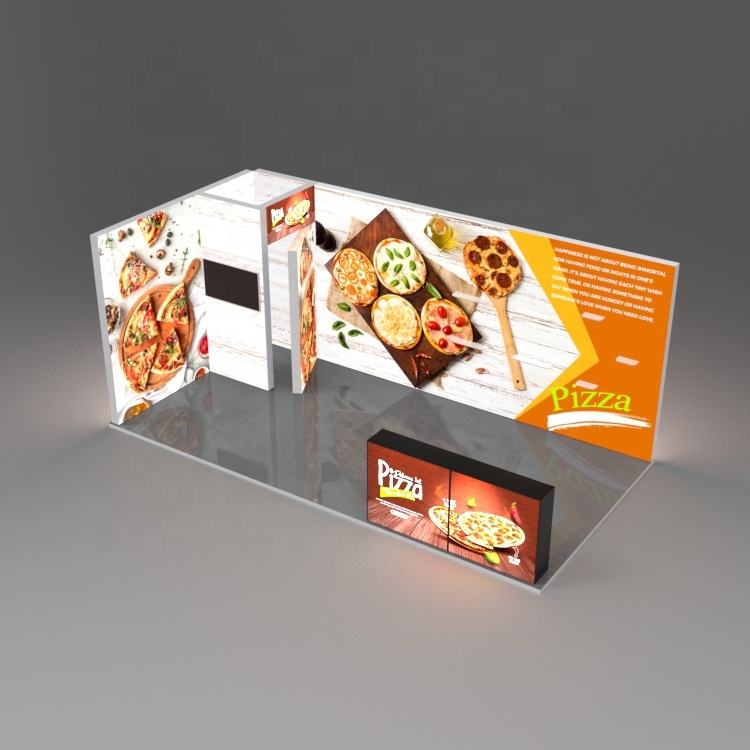
What exactly gets replaced when changing the SEG graphic fabric?Which parts in the frame must be retained
When replacing the SEG graphic fabric, what is replaced is the fabric surface, not the frame. In the QingSuYv QSY-BX BOX Booth, the SEG graphic fabric is a soft graphic that is inserted into the frame groove and tensioned by silicone edge strips. It is responsible for brand visual output and itself does not bear weight or determine the booth form. The frame is responsible for structure, light strip layout, and overall dimensions, and is a reusable part.
What is the relationship between the graphic fabric and the frame of the QSY-BX BOX Booth?
The two have a relationship in which "the graphic depends on the frame": the graphic fabric is fully custom-colored and can be remade according to the theme of each exhibition;The frame is made of aluminum alloy tubes + UL94 V-0 flame-retardant PVC. When the structure remains unchanged, only the fabric surface needs to be replaced. Therefore, the same framework can be reused across multiple exhibitions, with the graphics updated according to the theme.
Which framework components must not be disassembled when replacing the graphics?
The following components should be kept as they are when replacing the graphics:
- Aluminum alloy tube main frame: It determines the shape and dimensions of the booth. Disassembling and reassembling it will affect the fitting precision and increase on-site labor hours.
- LED light strips and back panel: They are fixed to the inner side of the frame, and the graphics merely cover them. No disassembly is needed when replacing the fabric.
- Card slots and silicone insertion strips: The graphic is tucked into the groove along the silicone edge; the groove is part of the frame and can be kept as is.
- Connectors and corner brackets: Load-bearing and positioning components; not involved when replacing the graphic.
- Reception desk structure: Independent of the graphic; stays in place when replacing the fabric.
The only thing that truly needs replacing is the old SEG graphic fabric;If the new graphic comes with its own hook-and-loop fasteners or hanging strips, replace them together with the new graphic. If the size of the new graphic or the specifications of the insertion strip are inconsistent with the QSY-BX BOX Booth frame, then it is not a simple fabric replacement; it is recommended to confirm with the QingSuYv team whether the frame is still compatible.
From design to on-site installation of the graphic fabric: a repeatable replacement process
When multiple exhibitions share one framework, whether the graphic fabric can go from design to on-site installation following the same set of steps each time directly determines on-site efficiency. Any temporary fix may turn into wrinkles or misaligned edge strips at the next show.
What to pay attention to in finalizing the design and placing the production order
The design files must correspond one-to-one with the actual grid divisions of the framework. The 3×3m structure of the QSY-BX BOX Booth includes a backlit wall, double-sided graphic pillars, and a reception desk. The graphic sizes at different positions are not the same. Before finalizing the design, each graphic should be numbered by position to avoid relying on on-site comparison for identification. Mark the visible area and bleed area clearly on the design draft so that the production side can be more confident that the pattern will not be pressed down by the silicone edge strips.
When placing the order, write the framework model, graphic number, and corresponding position of each piece into the production order. When the same frame set is reused across different events, the graphic files should be kept as editable source files, so that for the next event only the content is changed and not the dimensions; the edge strip positions and tension will not change due to re-layout.
Steps for transport folding, on-site installation, and disassembly and storage
Transport folding: It is recommended to roll the graphic fabric for storage rather than fold it. Hard creases caused by folding will be magnified under backlighting. When rolling, keep the graphic facing outward and the edge strips facing inward, and bag each roll separately, away from the aluminum profiles, to avoid the edge strips being imprinted by the sharp corners of the frame.
On-site installation: First complete the frame assembly and confirm it is level, then hang the graphic from bottom to top and from the center to both sides. First secure the four corners so the graphic is naturally tensioned, then press the edge strips into the grooves section by section. If slight slack appears, push from the adjacent edge strips toward the middle rather than pulling on the graphic itself.
For graphics on backlit walls and columns, do a final unified check to confirm whether the edge strips are fully seated in the grooves—edge strips that are not fully seated will create obvious dark edges once the lights are on.
Disassembly and storage: First disconnect the power, then remove the edge strips section by section; do not pull directly on the graphic. Immediately roll up and store the removed graphic to avoid leaving it on the floor where it can pick up dust. For graphics at high-traffic locations such as reception desks, it is recommended to mark them separately so that edge strip wear can be checked first at the next event.
If on site you find that the graphic size does not match the frame, or that the edge strips have hardened or come unstitched after repeated use, these are issues that need to be confirmed with the production side; it is not recommended to cut or sew them yourself on site. Depending on the specific graphic material and event frequency you use, you can explain your usage conditions to the QingSuYv team to confirm the more suitable edge strip specifications and storage method.
What should you do if the graphic gets dirty or wrinkled?On-site maintenance and storage methods between multiple exhibitions
Common on-site issues: handling boundaries for wrinkles, contamination, and size deviation
SEG graphic fabric is a soft material, and on-site issues are concentrated in three categories: wrinkles, contamination, and size deviation.
Wrinkles: For slight wrinkles, first try re-tensioning and check whether the silicone strip is fully pressed into the frame groove, especially at the four corners and the middle sections of the long edges. If it is still not flat after re-tensioning, it is necessary to evaluate whether the graphic fabric needs to be remade.
Staining: The cleaning method should be selected according to the PVC material. It is recommended to use a gentle method to avoid damaging the coating. Please confirm the specific type of cleaning agent with the supplier, as the coating tolerance may vary between different batches.
Size deviation: First check whether the frame slot positions and the graphic cloth specifications are consistent. If new cloths generally become loose after the same frame has been used with multiple sets of graphics, there may be residual debris in the slots or slight deformation of the frame; the slot openings need to be cleaned and the frame condition checked.
How should graphic cloths be stored between multiple exhibitions so they are less likely to be damaged?
After each event, the graphic fabric should be cleaned and completely dried before storage. It is recommended to fold or lay flat, or roll it up, avoiding heavy pressure and humid environments. Classify by exhibition markings to avoid mismatched sizes after mixed use.
Store the frame and graphic fabric separately, and pay attention to dust protection at the slots.
For details such as the specific roll diameter and acceptable folding duration, it is recommended to confirm with the supplier.
Who is suitable for reusing the frame and changing the graphic for each event? Who is not suitable? Budget and complexity boundaries
Frame reuse, changing graphics for each show, is essentially splitting the budget into a "reusable skeleton" and "graphics swapped per show." Whether it's worth it depends on the number of exhibitions per year and the frequency of graphic changes.
Who it's recommended for: brands that exhibit at multiple shows annually and need to change graphics frequently
If you participate in multiple overseas exhibitions in the same fiscal year, and each show has a different theme, featured product, or promotional message, this model is worth prioritizing. The aluminum alloy frame of the QingSuYv QSY-BX BOX Booth can be reused across multiple shows, requiring only the SEG graphic fabric to be replaced each time. For teams with short move-in and move-out time windows, the on-site labor hours saved may be more critical than the graphic fabric itself.
Who it's not recommended for: users with a single show or graphics that stay unchanged long-term
If you only do one show a year, or don't change graphics for over a year, the advantages of frame reuse are basically unused. The premium paid for a "replaceable structure" cannot be recouped through the value of a second use; putting the budget into graphic design or on-site experience yields more direct returns.
Budget and complexity boundaries
| Judgment dimensions | Lean toward reusing and changing graphics | Lean toward single-use fixed setup |
| Number of exhibitions per year | Multiple events | Only one event |
| Graphics replacement frequency | Replace every show or every season | Unchanged for over a year |
| Storage and transportation | Can store frames and rolled graphic fabric | No long-term storage conditions |
The budget should be built around total cost of ownership, not the one-time purchase price: the initial purchase of frames and graphics, the production cost of replacing graphics per trade show, transportation and packaging, and on-site installation labor all need to be included. The tradeoff is that reusing frames lowers long-term costs, but replacing graphics increases the complexity of operational processes—each show's graphics need to be designed separately, numbered, and stored in rolls. If no one follows up on version management, changing graphics can become an on-site risk. Whether it is worth it depends on whether "changing graphics" can be turned into a standard action.
Specific amounts and savings ratios need to be substituted according to your own situation; this article does not provide specific figures.
Frequently Asked Questions
Q1: If I only participate in two exhibitions a year, is it worth choosing a reusable frame? If the two events are close together, the graphics differ greatly, and you want to quickly change the setup for the second event, it can be considered;otherwise, a one-time fixed solution saves more budget.
Q2: Do I need professional personnel to change the graphic fabric? SEG graphic fabric paired with a tool-free frame allows routine replacement to be completed by setup personnel, but for the first time it is recommended to follow the supplier's instructions.
Q3: How should the graphic fabric be stored so it will not affect the next use? It is recommended to store in rolls, label the event and version, and avoid folding creases. The specific rolling method can be confirmed with the QingSuYv team.
Q4: How can you determine whether the graphic replacement frequency is high enough? Count the actual number of replacements over the past 12 months. If it is fewer than 2 times, the marginal benefit of frame reuse is limited;if it reaches 3 times or more, you can further confirm the graphic fabric matching and maintenance plan.
Learn more
If you are evaluating using one set of 3×3m SEG light box frames for multiple exhibitions, you can send us the annual number of events, the graphic replacement frequency per event, storage conditions, and entry time windows. The QingSuYv team will help determine whether frame reuse matches your operating rhythm based on this, and provide graphic fabric matching and storage recommendations.