Fast62 Aluminum Frame vs. Traditional Truss: Structure and Working Principle of Two Booth Frames
The stability and construction speed of a booth frame depend first on its material and connection method. Below, we directly break down "what" the two frames are and "how they work" to help you quickly determine which structure is more suitable for your project.
Fast62 Aluminum Frame: How 62mm Profiles and Welded Corner Brackets Achieve a Stable Structure
The core material of the Fast62 aluminum frame ishigh-strength 62mm aluminum alloy profiles, with a cross-section of 65.5mm × 45.5mm. This profile is lightweight yet rigid, does not rust, and can be reused dozens of times.
Its connection method is not bolting or welding on-site assembly, butprefabricated welded corner fittings—the corner fittings and profiles are welded together in the factory, and on-site only need to insert the profiles into the corner fittings and fix them with special locks. This means:
- No on-site measurement, cutting or welding, all connection points are positioned at the factory.
- High structural integrity, welded corner fittings eliminate the risk of wobbling caused by loose bolts or deformed wooden frames.
- Maximum construction height is 4.5m, suitable for exhibition booths that require high-altitude display or hanging heavy objects.
Simply put, Fast62 is like a set of "prefabricated building blocks": each profile and corner piece has a fixed angle, and they can be assembled on site by plugging together. The structural stability relies on welded joints rather than on-site craftsmanship.
Traditional Truss: How Bolt-Connected Steel or Wood Frames Work
Traditional trusses typically usesteel frames (square or round tubes) or wood frames (plywood + timber). Steel frames are heavy but have high load-bearing capacity, while wood frames are light but prone to moisture deformation.
The connection method isBolts or screws are tightened on siteMainly:
- Steel truss: Use bolts to connect segmented trusses into a whole, requiring a wrench to tighten, and shims may be added at joints to adjust angles.
- Wood truss: Use self-tapping screws or nails to fix wooden beams to plywood, with on-site cutting, drilling, and assembly.
The problems with this structure are:
- Connection points rely on manual precision: Loose bolts or misaligned wood screws can cause the frame to wobble.
- On-site adjustments are time-consuming: Dimensional deviations require on-site adjustment; steel frame cutting requires an angle grinder, while wood frame cutting requires an electric saw.
- Poor reusability: Steel frame bolt holes may strip, and wood frames are prone to cracking after disassembly and reassembly.
Key Trade-off: Which Should You Choose?
| Comparison Dimension | Fast62 Aluminum Frame | Traditional Truss (Steel/Wood) |
| Material | Aluminum alloy profile (62mm) | Steel square tube or wood square + plywood |
| Connection method | Prefabricated welded corner brackets + locking buckles | Bolts/screws tightened on site |
| On-site tool requirements | Only hex key required | Wrench, angle grinder/circular saw, electric drill |
| Number of reuses | Dozens of times (profile does not deform) | Steel frame 3-5 times (bolt hole wear), wooden frame 1-2 times (cracking) |
| Maximum height | 4.5m (welded joints are more reliable) | Steel frame can reach 6m+, but requires more diagonal bracing; wooden frame is typically ≤3m |
Scenarios suitable for Fast62: Requires quick setup (1-2 days), reusable, height within 4.5m, sensitive to on-site noise and dust (e.g., inside exhibition halls).
Scenarios suitable for traditional trusses: Single use, extremely low budget, requires height exceeding 4.5m, with a professional welding team on-site.
Next confirmation steps
If you are considering Fast62, it is recommended to confirm the following two points with the current website team:
- Does the highest point of your booth exceed 4.5m? If so, Fast62 cannot meet the requirement, and steel trusses or other solutions need to be considered.
- Does your booth need to suspend objects weighing over 200kg? The load-bearing capacity of Fast62 needs to be confirmed based on the specific suspension point location. Please provide the weight of the suspended object and the position diagram to the team for evaluation.
Stability test comparison: Fast62 welded corner brackets vs. traditional truss bolted connections, which is more reliable?
Fast62 welded corner brackets: How the integrated structure improves overall rigidity
Fast62 uses 62mm aluminum alloy profiles. At the corners, the profiles and corner brackets are fused together through welding, forming a continuous rigid load transfer path. This integrated structure eliminates the joint gaps that may occur in traditional bolted connections due to repeated assembly and disassembly, making the overall frame stability more reliable. According to product documentation, Fast62 can be built up to a maximum height of 4.5 meters, suitable for exhibition booth scenarios requiring higher stability.
Traditional truss bolted connections: Risk of joint loosening and long-term stability
Traditional trusses rely on bolts to fasten multiple thin tubes. After transportation vibrations or repeated assembly and disassembly, the threads may wear or the preload may decay, leading to a decrease in frame rigidity. In contrast, the Fast62 welded corner fittings have no movable contact surfaces and will not develop gaps due to repeated use. For exhibition frames planned to be reused more than 10 times, the welded corner fitting structure offers greater advantages in long-term stability.
Actual assembly speed comparison: How does the Fast62 modular design enable a medium-sized booth to be completed by 2 people in 4-6 hours?
Assembly speed directly determines the project timeline and labor costs of an exhibition booth. Below, we use actual data to compare the performance of the Fast62 system and traditional trusses when building a medium-sized booth (approximately 30-50 sqm).
Fast62: No tools required, 2 people can quickly assemble
The core of the Fast62 system is the modular plug-in structure, with all connectors adopting a quick-lock design, eliminating the need for wrenches, screwdrivers, or electric drills throughout the process. For a standard medium-sized booth,2 skilled workerscan complete the main frame assembly in about4-6 hours。
Specific process:
- Lay out positioning lines on the ground and place base connectors
- Insert the 62mm aluminum profile columns into the bases without bolt fixing
- Snap the horizontal and diagonal profiles into the column slots using quick-lock connectors; a "click" sound indicates locking
- Install the top beams and corner connectors to complete the frame closure
- Hang fabric or panels (using matching card strips, no additional tools required)
Key advantages:No need to wait for bolt tightening, no repeated levelingbecause the profiles and connectors are precision-machined and self-align when plugged together.
Traditional truss: bolted connection, higher labor and time costs
Traditional trusses (e.g., 30×30mm or 40×40mm square tube trusses) typically require3-4 peopleand take8-12 hours. The reason is:
- Each truss member needs to be connected at both ends with bolts and nuts, requiring at least 4-6 bolts to be tightened
- Large number of connection points: a medium-sized booth requires approximately 80-120 bolt connection points
- Wrenches or power tools are needed, and bolts must be tightened gradually in a diagonal sequence, otherwise the frame will deform
- During construction, leveling must be repeatedly adjusted because there is cumulative error from gaps in the bolted connections
| Labor cost comparison(taking the domestic market as an example): | System | Number of People | Work Hours | Total Man-Hours |
| Fast62 | 2 People | 5 Hours | 10 Man-Hours | |
| Traditional Truss | 3-4 people | 10 hours | 30-40 man-hours |
Who Should Choose Fast62?Who Should Continue Using Traditional Truss?
Situations Suitable for Fast62:
- Tight exhibition schedule requiring same-day setup and completion
- Limited number of workers or high labor costs (e.g., exhibitions in Europe and America)
- The same booth needs to be repeatedly assembled and disassembled (Fast62 can be directly reused after disassembly without re-drilling or replacing bolts).
Still suitable for traditional truss situations.:
- Booth height exceeds 4.5 meters (Fast62 maximum height is 4.5 meters).
- Need to hang extremely heavy loads (such as LED screens or mechanical equipment over 200 kg).
- The construction team has been using traditional trusses for a long time and is unwilling to change tools and processes.
Next confirmation steps
If you plan to use Fast62, please provide the following information to our team to confirm the specific plan:
- Length, width, and height of the booth (whether within 4.5 meters).
- Total weight of the screens or lights to be hung.
- Are there any ground restrictions for the setup site (such as no drilling or laying floor mats)?
We will provide you with an accurate list of profiles, connectors, and estimated setup time based on your actual booth dimensions and load requirements.
Selection advice: When to choose Fast62 and when to choose traditional truss?
The key to selection is not about which is better, but which system's design premise better matches your project conditions. Below are the criteria for judgment.
Scenarios recommended for Fast62: repeated use, height below 4.5 meters, curved requirements
- The same booth needs to be set up repeatedly more than 3 times: The aluminum profile frame of Fast62 can be assembled and disassembled dozens of times, with a single amortized cost lower than the one-time welding or repeated rental costs of traditional trusses.
- The erection height is within 4.5 meters: This is the limit height of Fast62. Within this range, its welded corner joints can better ensure overall rigidity without additional reinforcement.
- The booth design includes curved elements: Fast62 provides full-size curved frame components. Traditional trusses require custom bending for curves, which is costly and time-consuming.
- There are clear requirements for erection speed: Modular quick-assembly structure allows a skilled team to complete a medium-sized booth within hours, saving about 40% labor hours compared to traditional bolted trusses.
- Need to meet European/American venue fire safety standards: Optional flame-retardant fabrics are available without additional spray treatment.
Scenarios where Fast62 is not recommended: single use, ultra-high booth, extremely low budget
- One-time small booth (e.g., under 9 square meters): Traditional truss rental costs are lower, and the investment in Fast62 cannot be recouped in a single use.
- Booth height exceeding 4.5 meters: Fast62 does not support higher construction; in this case, traditional trusses (which can reach 6 meters or even higher) must be chosen.
- Extremely tight budget with no plan for reuse: The initial investment for traditional trusses (especially second-hand or rental) is much lower than the Fast62 system.
- Need for extensive on-site welding or cutting modifications: Fast62 is a standard modular system, and on-site size modifications can only be done by replacing components, making it unsuitable for projects that require frequent non-standard customization.
Key Trade-off Quick Reference
| Judgment Dimension | Choose Fast62 | Choose Traditional Truss |
| Number of Uses | ≥3 times | 1-2 times |
| Maximum Height | ≤4.5m | Can exceed 4.5m |
| Curved Requirement | Yes | None or Very Few |
| Budget Model | Procurement (Long-term Amortization) | Rental or One-time |
| Fire Protection Requirements | European/American Standards | No Special Requirements |
Next confirmation steps: Please provide our team with your booth dimensions, estimated number of uses, whether there is an arc design, and the target exhibition country. We will provide specific plan comparisons and cost estimates based on these conditions.
Frequently Asked Questions
Q1: Can Fast62 be built to a height exceeding 4.5 meters? No. 4.5 meters is the design limit; beyond this height, the corner joints and profile sections cannot ensure structural safety with confidence.
If a taller booth is necessary, it is recommended to choose traditional trusses.
Q2: If I only use it once but want to keep the frame for future use, is Fast62 cost-effective? If you are certain of using it more than 3 times within the next 3 years, purchasing Fast62 is cost-effective. If it is just a "maybe" for future use, it is recommended to rent traditional trusses first, and purchase only after confirming repeated needs.
Q3: How much higher would the cost be for a curved booth using traditional trusses compared to Fast62? Traditional trusses for curved booths require custom bent pipes or curved connectors, typically increasing costs by 30%-50% and extending the construction period by 2-3 days. The curved components of Fast62 are standard parts and do not require additional customization.
Q4: Does the flame-retardant fabric of Fast62 comply with domestic fire safety standards? The fabrics used with Fast62 are primarily designed for European (EN 13501) and American (NFPA 701) standards. If you need compliance with the Chinese GB 8624 standard, please inform us in advance so we can confirm compatibility or provide an alternative solution.
Q5: Which saves more labor, traditional truss rental or Fast62 procurement? The modular design of Fast62 can reduce erection labor hours by approximately 40%. Traditional trusses (especially bolted types) require more fastening and adjustment time.
However, Fast62 requires the team to undergo simple training to realize its speed advantage.
Learn More
If you are evaluating frame solutions for your next booth project, feel free to submit your booth dimensions, usage frequency, and special requirements (such as curved design or fire resistance) to us. Our team will provide targeted solution comparisons and cost estimates to help you make more efficient decisions.
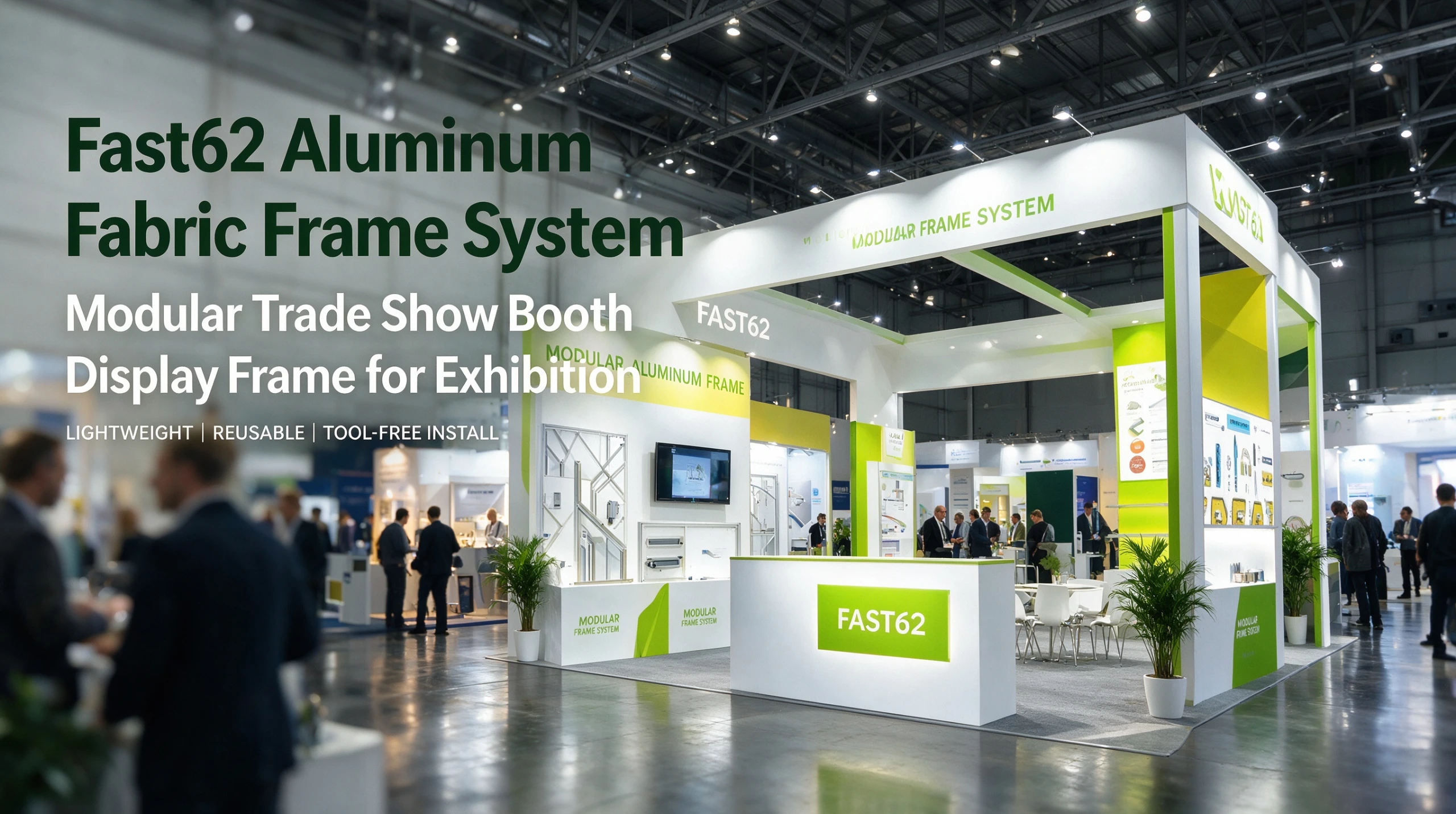
Related Products:Fast62 Aluminum Fabric Frame System | Modular Trade Show Booth Display Frame for Exhibition